
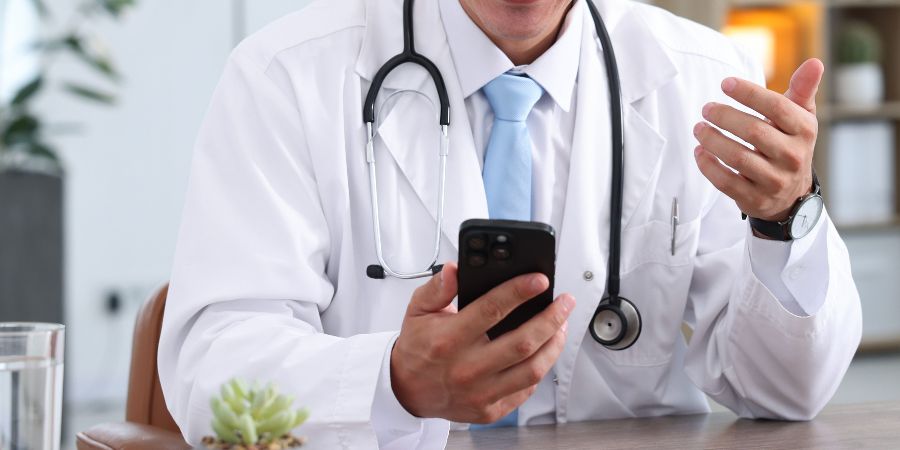
There was a time when seeing a doctor meant going somewhere.
You booked an appointment, travelled to a clinic or hospital, waited your turn, explained what was wrong and then travelled back home. For many people, that process is still perfectly reasonable. But for someone living far from a specialist, a parent managing a sick child, an older person with mobility difficulties or a patient who needs a quick follow-up rather than another trip to the hospital, the journey itself can become part of the problem.
This is where telemedicine comes in.
What is Telemedicine?
Telemedicine is the delivery of clinical healthcare when the patient and healthcare professional are in different locations, using telecommunications and digital technologies such as video, telephone, secure messaging and connected medical devices.
That is the simplest telemedicine meaning, but there is a little more to it.
Telemedicine can support consultation, diagnosis, treatment, follow-up and certain forms of remote patient monitoring. A patient may speak to a doctor over video, discuss symptoms on the telephone, send a photograph for clinical review or share health readings collected at home.
WHO describes telemedicine as a specific type of digital health service involving synchronous or asynchronous clinical care delivered at a distance. It sits within the broader concept of telehealth.
The important word here is clinical.
Telemedicine is not simply downloading a health app or searching Google for symptoms. It involves healthcare professionals using technology to provide appropriate clinical services.
And no, telemedicine does not mean that hospitals, clinics or physical examinations are becoming unnecessary.
Some conditions still require a physical examination, laboratory testing, imaging, procedures or immediate emergency treatment.
In this article, we will look at:
- how does telemedicine work
- The main types of telemedicine
- Common telemedicine examples
- The benefits and limitations of telehealth
- telemedicine vs telehealth
- Technology used in virtual healthcare
- Privacy and regulatory concerns
- What to expect from an online doctor consultation
The interesting part is not really whether healthcare can happen online. It can.
The more useful question is: when should it?
How Does Telemedicine Work?
Telemedicine works by allowing a patient and healthcare professional to communicate remotely, exchange relevant medical information, assess the patient’s condition and decide whether treatment, monitoring, referral or an in-person visit is appropriate.
The process is usually quite simple from the patient’s perspective.
Book → Connect → Explain → Assess → Treat or Refer → Follow Up
Step 1: Book an appointment
The patient schedules a consultation through a healthcare provider’s website, mobile application, patient portal or telephone service.
The appointment may be for a new concern, routine follow-up, medication review or chronic-condition management.
Step 2: Connect with the clinician
The online doctor consultation may happen through:
- Video
- Telephone
- Secure messaging
- A patient portal
Not every consultation needs video.
A medication follow-up, for example, may be perfectly manageable over the telephone. A visual assessment may make video more useful.
Step 3: Explain the problem
The patient describes symptoms, medical history, current medicines and relevant concerns.
The clinician may also review:
- Previous medical records
- Test results
- Prescriptions
- Photographs
- Diagnostic reports
- Home health measurements
Step 4: Assess the situation
This is the part people sometimes underestimate.
A doctor is not simply having a conversation with the patient. The clinician is deciding whether there is enough reliable information to make a clinical decision remotely.
Sometimes there is. Sometimes there isn’t.
Step 5: Decide what happens next
Depending on the situation, the healthcare professional may:
- Recommend treatment
- Prescribe medication where permitted
- Order tests
- Refer the patient to another specialist
- Schedule another consultation
- Ask the patient to visit a clinic or hospital
India’s telemedicine guidelines make this principle particularly clear: the registered medical practitioner should use professional judgment to determine whether technology-based consultation is sufficient or an in-person review is necessary.
Step 6: Continue care
This is where virtual healthcare becomes more interesting than a simple video appointment.
A patient may continue communicating with the healthcare team through follow-ups, digital records or remote patient monitoring.
Telemedicine can be synchronous, where the patient and clinician communicate in real time, or asynchronous, where information is collected and reviewed later.
Both have a place.
What are the Main Types of Telemedicine?
The main types of telemedicine are synchronous care, asynchronous or store-and-forward care, and remote patient monitoring.
1. Synchronous telemedicine
This is healthcare happening in real time.
The patient and clinician communicate at the same time through video or telephone.
Telemedicine examples include:
- Virtual primary-care appointments
- Mental-health consultations
- Follow-up visits
- Medication reviews
- Specialist consultations
This is probably what most people picture when they hear the word telemedicine.
2. Asynchronous telemedicine
This is sometimes called store-and-forward telemedicine.
The patient or healthcare provider collects medical information and sends it to another professional who reviews it later.
For example, a patient might upload a photograph of a skin condition along with their symptoms and medical history. A dermatologist can review the information without both people needing to be online simultaneously.
This approach can be particularly useful when immediate interaction is not necessary.
3. Remote patient monitoring
Remote patient monitoring involves collecting health information outside a traditional healthcare setting and transmitting it to a healthcare team.
Depending on the condition, this could include:
- Blood pressure
- Blood glucose
- Heart rate
- Oxygen saturation
- Weight
- Other health measurements
The important division is that monitoring is not simply collecting numbers. Those numbers need to be interpreted within a clinical context.
And the evidence is nuanced. A 2025 review found that the clinical benefits and risks of remote monitoring remain insufficiently studied for several patient groups, which is a useful reminder not to confuse promising technology with automatically proven outcomes.
What is the Difference Between Telemedicine and Telehealth?
Telemedicine refers specifically to remote clinical care, while telehealth is a broader term that can include telemedicine along with other digital health activities.
This is one of those distinctions that sounds academic until you start researching digital healthcare. Then it becomes important.
Telemedicine
Generally focuses on clinical services such as:
- Consultation
- Diagnosis
- Treatment
- Clinical follow-up
- Certain forms of remote monitoring
Telehealth
Can cover telemedicine as well as broader activities such as:
- Health education
- Professional training
- Remote support
- Administrative functions
- Some digital diagnostic services
- Broader digital health activities
WHO’s 2025 policy brief makes the distinction explicitly: telemedicine is a specific type of remote clinical care, while telehealth covers a wider range of digital healthcare activities.
So, if someone asks telemedicine vs telehealth, remember this:
Telemedicine is part of telehealth, but telehealth is broader than telemedicine.
They overlap. They are not identical.
|
Feature |
Telemedicine |
Telehealth |
|
Meaning |
Remote clinical healthcare |
Broader use of technology for healthcare |
|
Scope |
Primarily clinical services |
Clinical and non-clinical activities |
|
Diagnosis |
Yes |
Can include it through telemedicine |
|
Treatment |
Yes |
Can include it through telemedicine |
|
Remote patient monitoring |
Can be included |
Yes |
|
Health education |
Not usually the primary focus |
Yes |
|
Professional training |
Not usually the primary focus |
Yes |
|
Administrative services |
Limited |
Can include them |
|
Examples |
Virtual doctor consultation, remote clinical follow-up |
Telemedicine, health education, remote monitoring and digital health support |
What is Telemedicine Used For?
Telemedicine is used for routine consultations, follow-up care, chronic disease management, mental healthcare, selected specialist services, rehabilitation, medication management and some forms of remote monitoring.
The practical telemedicine examples are actually quite ordinary. That is a good thing.
Routine and primary care: Telemedicine can be useful for:
- Minor illnesses
- Routine consultations
- Follow-up appointments
- Medication reviews
Chronic disease management: People living with long-term conditions may require regular contact with healthcare professionals without needing a physical visit every time.
Depending on the condition, this can include:
- Diabetes
- Hypertension
- Asthma
- Heart disease
Mental healthcare: Mental healthcare has become one of the more visible applications of virtual healthcare.
Depending on local rules and clinical needs, telemedicine may support:
- Psychiatry
- Counselling
- Psychotherapy
- Follow-up care
Specialist consultations: Telemedicine can also reduce the importance of geographical distance for selected specialist services.
Examples may include:
- Dermatology
- Cardiology
- Ophthalmology
- Radiology
- Pathology
Rehabilitation: Certain rehabilitation programmes can incorporate remote consultations, exercise guidance and follow-up.
Medication management: An online doctor consultation may also be used for medication reviews, follow-ups and refills where legally and clinically appropriate.
Second opinions: Perhaps one of the most useful applications is specialist access. A patient does not necessarily have to travel hundreds of kilometres simply to have an initial conversation with a specialist.
Of course, licensing and cross-border rules still apply.
What Technologies Are Used in Telemedicine?
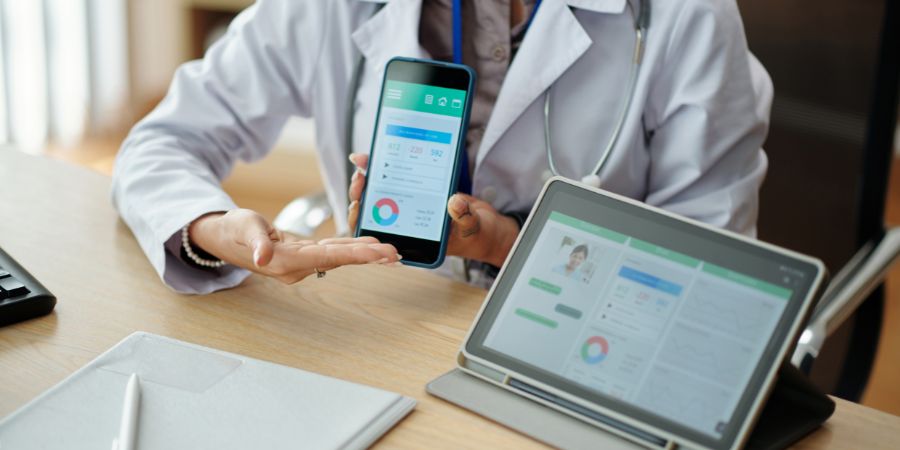
Telemedicine can work with basic technologies such as telephones and smartphones, but modern services may also use secure video, electronic health records, connected devices, cloud systems, IoT and AI-assisted tools.
You do not need a futuristic hospital to deliver telemedicine.
Sometimes you need a phone. Other services are considerably more sophisticated.
Patient-facing technologies
- Smartphone
- Tablet
- Computer
- Telephone
- Secure video platform
- Patient portal
Clinical technologies
- Blood-pressure monitors
- Glucose monitors
- Pulse oximeters
- Wearable devices
- ECG/EKG devices
- Digital diagnostic equipment
Healthcare infrastructure
- Electronic health records
- Cloud systems
- Secure data transmission
- Interoperability systems
- Internet of Things technology
|
Technology |
How it is used |
Example |
|
Smartphone |
Communication and healthcare apps |
Online doctor consultation |
|
Computer or tablet |
Video and portal-based consultations |
Virtual doctor consultation |
|
Telephone |
Audio-only clinical consultations |
Medication follow-up |
|
Video conferencing |
Real-time visual consultation |
Primary-care appointment |
|
Patient portals |
Secure exchange of health information |
Reports, prescriptions and messages |
|
Wearable devices |
Collect health measurements |
Heart rate monitoring |
|
Blood-pressure monitors |
Capture home readings |
Hypertension monitoring |
|
Glucose monitors |
Track blood glucose |
Diabetes management |
|
Pulse oximeters |
Measure oxygen saturation |
Respiratory monitoring |
|
Electronic health records |
Store and share clinical information |
Medical history review |
|
IoT-connected devices |
Send health data automatically |
Remote patient monitoring |
|
AI-assisted tools |
Support selected healthcare workflows |
Documentation or decision support |
What about AI?
AI is increasingly being discussed alongside telehealth and digital healthcare, but it is important not to overstate its role.
A telemedicine appointment does not require AI.
AI may eventually support documentation, triage, clinical decision support, pattern recognition and other tasks, but the fundamental service can still be as simple as a patient speaking to a doctor on the telephone. That difference is important because technology should solve a healthcare problem, not become the problem that healthcare has to solve.
What are the Benefits of Telemedicine?
The key benefits of telemedicine include greater convenience, reduced travel, improved access to healthcare professionals and easier follow-up, particularly for patients who face geographical or mobility barriers.
For patients, the advantages can be practical rather than dramatic:
- Less travel
- Fewer unnecessary visits
- Easier specialist access
- More convenient follow-ups
- Potentially shorter waiting times
- Greater flexibility
- Support for some rural and underserved communities
For healthcare providers, telemedicine can help extend services across larger geographical areas.
It can also make some follow-up care more flexible and create additional opportunities for remote patient monitoring.
WHO has identified benefits including improved accessibility, shorter waiting times, better follow-up and management, and potential cost reductions. But there is a catch that deserves more attention.
Access to telemedicine is not the same thing as access to healthcare.
Someone without reliable internet, a suitable device, digital skills or a service available in their region may not benefit at all.
So, the success of virtual healthcare depends on more than technology.
It depends on whether people can actually use it.
What are the Limitations and Risks of Telemedicine?
The biggest limitations of telemedicine are the inability to perform every physical examination remotely, technology barriers, privacy concerns, fragmented health records and differences in regulation.
Because telemedicine is useful precisely because it does not try to be everything.
- A screen cannot replace hands-on examination: A doctor cannot palpate an abdomen through a smartphone. They cannot take a blood sample through a video call. They cannot perform every procedure remotely. This sounds obvious, but it is at the heart of responsible telemedicine.
- Emergencies remain emergencies: Someone experiencing severe or rapidly worsening symptoms should not delay emergency care because they are trying to arrange an online doctor consultation. Telemedicine has a role in healthcare. It is not a substitute for emergency services.
- Technology can become a barrier: A poor internet connection can interrupt a consultation. A patient may not know how to use the platform. A device may not support the required application. These are not minor inconveniences for people who depend on digital access.
- Privacy matters: Medical information is highly sensitive. Patients should use reputable platforms, secure connections and private spaces where possible. Healthcare providers also need appropriate safeguards for storing, transmitting and accessing patient information.
- Fragmented records can weaken continuity: Imagine seeing one doctor through one platform, another specialist through a different hospital and a third provider through a separate system. If those records cannot communicate, the convenience of telehealth can create a different problem: information fragmentation.
- Regulations are not universal: Licensing, prescriptions, reimbursement, consent and cross-border consultations can all be governed differently. WHO’s implementation guidance emphasises that successful telemedicine programmes require more than technology. Governance, infrastructure, financing, workforce capacity and implementation planning matter too.
This is why the future of telemedicine will depend as much on healthcare policy as it does on better apps.
Is Telemedicine Suitable for Everyone?
No. Telemedicine is suitable for many routine consultations and follow-ups, but it is not appropriate for every condition or every patient.
A physical visit may be necessary when someone needs:
- A physical examination
- Laboratory testing
- Imaging
- A procedure
- Hands-on treatment
- Emergency assessment
The patient’s condition should determine the method of care.
India’s official telemedicine guidelines make the same point: the registered medical practitioner must exercise professional judgment and decide whether remote consultation is appropriate or whether an in-person review is required.
That is probably the healthiest way to think about virtual healthcare.
Not as a replacement. As another route into the healthcare system.
How Do You Prepare for a Telemedicine Appointment?
Prepare for a telemedicine appointment by checking your technology, gathering your medical information and writing down the questions you want to discuss.
Before your appointment:
- Test your internet connection.
- Charge your device.
- Find a reasonably quiet and private place.
- Keep your medicines nearby.
- Note when your symptoms started.
- Write down your questions.
- Keep recent test results available.
- Have relevant photographs or reports ready.
- Check whether identification or insurance details are needed.
- Join the appointment a few minutes early.
And one small piece of advice: do not assume you will remember everything once the doctor joins the call.
Write it down.
People forget symptoms, medication names and questions all the time.
Is Telemedicine Available Worldwide?
Yes, telemedicine is used across healthcare systems worldwide, but availability, regulation, reimbursement, licensing, infrastructure and digital access vary from one country to another.
There is no single global telemedicine system.
Some countries have incorporated digital consultations into public healthcare. Others rely more heavily on private providers. Insurance coverage differs. Prescription rules differ. Cross-border consultations can create additional licensing complications.
Even within countries, access can vary between urban and rural communities.
WHO’s work in the European Region illustrates the uneven picture. Its 2025 policy brief notes that telemedicine has expanded but that countries differ considerably in how services are implemented and integrated into health systems.
India offers an interesting example: The government’s eSanjeevani programme was developed as a national telemedicine service, using a hub-and-spoke model to connect healthcare facilities and specialists. Government material describes its nationwide rollout across more than 1.76 lakh Ayushman Arogya Mandirs and corresponding hub centres.
That is vital because the real promise of telemedicine is not limited to people sitting in well-connected cities. It can be particularly valuable when distance is one of the biggest obstacles between a patient and a healthcare professional.
But digital access must be designed around people, not simply around technology.
What are the Most Common Telemedicine Examples?
Common telemedicine examples include video consultations, telephone appointments, asynchronous specialist reviews, virtual mental-health care and remote patient monitoring.
Consider a few everyday situations.
- A routine follow-up: A patient with a stable condition needs to discuss medication, symptoms and recent readings. There may be little value in spending hours travelling for a ten-minute conversation. A virtual appointment may make sense.
- A specialist review: A patient sends medical images or reports to a specialist for review. The specialist can determine whether the case can be managed remotely or whether the patient needs to travel for an examination.
- Chronic disease monitoring: A patient records blood pressure or glucose at home. The information is transmitted to the healthcare team, allowing the clinician to monitor trends rather than relying entirely on what the patient remembers during an appointment.
- Mental-health support: A patient attends a scheduled psychotherapy or psychiatry appointment from home. For some people, the familiar environment may make attending care easier.
- A second opinion: A patient who wants specialist input may be able to speak to a professional in another city without immediately travelling.
These are the telemedicine examples that show where the technology is genuinely useful. None of them requires us to pretend that every medical problem can be solved through a screen.
When Should You Choose Telemedicine vs In-Person Care?
|
Situation |
Telemedicine may be appropriate |
In-person care may be better |
|
Routine follow-up |
Yes |
Sometimes |
|
Medication review |
Yes |
Sometimes |
|
Mental-health consultation |
Often |
Sometimes |
|
Specialist second opinion |
Often |
Sometimes |
|
Chronic disease monitoring |
Often |
Sometimes |
|
Minor, non-emergency concerns |
Sometimes |
Sometimes |
|
Condition requiring physical examination |
Usually insufficient |
Yes |
|
Laboratory testing |
No |
Yes |
|
Imaging |
No |
Yes |
|
Medical procedure |
No |
Yes |
|
Severe or rapidly worsening symptoms |
No |
Yes |
|
Emergency |
No |
Yes |
What is the Future of Telemedicine?
The future of telemedicine is likely to involve a combination of remote consultations, in-person care, connected devices, electronic records and increasingly sophisticated digital tools rather than a complete replacement of traditional healthcare.
And honestly, that is probably how it should be.
The idea that telemedicine will somehow make hospitals obsolete has always seemed too simplistic to me.
Healthcare is not a single activity.
- Sometimes you need advice.
- Sometimes you need a prescription.
- Sometimes you need a specialist.
- Sometimes you need an X-ray.
- Sometimes you need surgery.
- Sometimes you need someone to look you in the eye and realise that something is not quite right.
Technology cannot erase those differences.
What it can do is make the journey between them easier.
WHO’s current approach to digital health also emphasises infrastructure, governance, equity and sustainable implementation rather than treating technology as an isolated solution.
That is where telehealth and telemedicine are heading: toward a healthcare system in which digital and physical services work together.
The technology will undoubtedly become smarter.
The more important question is whether healthcare systems become smarter about when to use it.
Frequently Asked Questions About Telemedicine
Can a doctor diagnose you through telemedicine?
Sometimes. A doctor can diagnose certain conditions remotely when the available symptoms, medical history, visual information and other data are sufficient. Some conditions require physical examination or testing.
Can telemedicine doctors prescribe medication?
Yes, in some circumstances. Whether medication can be prescribed depends on the clinical situation, the medicine involved and the rules of the jurisdiction where the service is provided.
Can telemedicine be done by phone?
Yes. Telephone consultations can be a form of telemedicine when they are used to provide appropriate clinical care remotely.
Does telemedicine replace in-person healthcare?
No. Telemedicine complements in-person healthcare. Some conditions require examination, testing, procedures or hands-on treatment.
Is telemedicine safe?
Telemedicine can be safe when it is used for appropriate clinical situations and delivered through suitable systems with appropriate privacy, security and clinical safeguards.
Conclusion
Telemedicine is a way of delivering clinical healthcare remotely using communication technologies such as video, telephone, secure messaging and connected devices.
Its appeal is obvious.
You can sometimes speak to a doctor without travelling, follow up on a condition without another waiting-room visit, access a specialist who is far away or share health information from your own home.
But the real value of telemedicine is not that it makes physical healthcare unnecessary.
It makes healthcare more flexible.
The best virtual healthcare systems will not ask patients to choose between technology and human care. They will use technology where it genuinely helps and bring the patient into a clinic or hospital when that is what good medicine requires.
That, ultimately, is where telemedicine makes the most sense: not as healthcare without hospitals, but as healthcare without unnecessary barriers.