

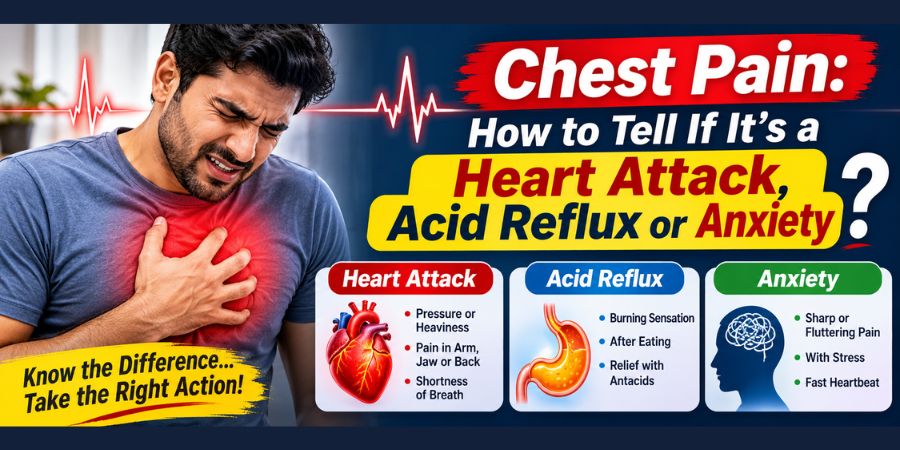
Medical warning: New, unexplained or persistent chest pain can signal a medical emergency. If it comes with breathlessness, sweating, nausea, dizziness or pain that spreads to the arm, jaw, back or shoulder, get emergency help immediately. Do not wait to see whether the discomfort fades, and do not assume it is acid reflux or anxiety. In India, call 112.
Chest pain is any discomfort, pressure or burning felt between the neck and the upper abdomen, and it frightens almost everyone who feels it. A burning sensation after a meal points toward acid reflux. Tightness during a stressful week looks like anxiety. A heart attack can feel almost the same as either one, so symptoms alone rarely settle the question.
The heart, the oesophagus and the nervous system all send signals from the same part of the body, and those signals overlap. Even the exact spot and the strength of the pain do not reliably show what is happening inside.
Most people who go to an emergency department with chest pain do not turn out to have a heart attack or another life-threatening problem. Studies put that share between 80% and 95%. Doctors can only say so after they have run the tests, though, and no symptom checklist can safely rule out a heart attack at home.
Also read: Why are More Young Adults Having Strokes? Causes, Risk Factors and Prevention
What Does Heart Attack-Related Chest Pain Feel Like?
A heart attack happens when blood flow to part of the heart muscle drops sharply or stops, usually because a blood clot has formed in a coronary artery. Without oxygen, the affected muscle starts to die.
The pain does not always arrive as the crushing, dramatic episode that films show. The American Heart Association (AHA) says many people describe pressure, squeezing, fullness or a heavy discomfort in the centre of the chest. It can last several minutes, fade and return, or build slowly.
Common heart attack symptoms include:
- Chest pressure: Tightness, heaviness, squeezing or fullness in the chest.
- Pain spreading elsewhere: Discomfort can travel to one or both arms, the shoulders, neck, jaw, back or upper abdomen.
- Shortness of breath: Breathing trouble can appear with or without chest discomfort.
- Cold sweating: Sudden sweating with no obvious physical cause.
- Nausea or vomiting: Some people write these off as an upset stomach.
- Dizziness or lightheadedness: Weakness, faintness or a feeling of being unsteady.
- Unusual fatigue: Sudden, unexplained exhaustion, which sometimes shows up before any other symptom.
Heart Attack Symptoms in Women, Older Adults and People with Diabetes
Heart attacks do not look the same in everyone, and that is one of the most important facts to know about them.
Women can feel the familiar chest pressure, but they also report unusual tiredness, nausea, breathlessness, back pain, shoulder discomfort or jaw pain. People often blame these symptoms on digestion, stress or plain exhaustion. The numbers back this up. A JAMA study of more than 1.1 million heart attack cases found that 42% of women had no chest pain when they reached hospital, compared with 31% of men. Overall, about 15% of the women died in hospital, compared with about 10% of the men.
Older adults may notice only vague discomfort, weakness, breathlessness or confusion. People with diabetes may feel less pain because diabetes can damage the nerves. Some heart attacks cause very mild symptoms or none at all. In a study of more than 9,000 middle-aged adults, published in the AHA journal Circulation, 45% of heart attacks were “silent,” meaning people had no recognisable symptoms and doctors found the damage later on an ECG. Those silent attacks still tripled the risk of dying from heart disease, according to the Mayo Clinic’s summary of the same evidence base on atypical presentations.
I think one point deserves repeating: mild pain does not mean a healthy heart. Unexplained breathlessness, sudden fatigue, nausea or discomfort in the jaw or back can still call for an urgent cardiac check.
How Acid Reflux Causes Chest Pain
Acid reflux is the backward flow of stomach contents, including digestive acid, into the oesophagus, the tube that connects the mouth to the stomach.
A muscular valve called the lower oesophageal sphincter normally blocks that backward flow. When the valve relaxes at the wrong moment or does not close properly, stomach acid irritates the lining of the oesophagus.
That irritation causes the burning sensation people call heartburn. When reflux keeps returning, it can develop into gastroesophageal reflux disease (GERD).
Common Acid Reflux Chest Pain Symptoms
Acid reflux can cause:
- A burning sensation behind the breastbone, often after eating.
- Discomfort that rises toward the throat.
- A sour or bitter taste in the mouth.
- Regurgitation of food or acidic liquid.
- Frequent belching or bloating.
- Symptoms that get worse when lying down or bending forward.
- A scratchy throat or a cough that will not go away.
Large meals, spicy or fatty foods, caffeine and lying down soon after eating trigger symptoms in some people. Triggers differ from person to person.
Why Can Heartburn Feel Like a Heart Attack?
The oesophagus runs through the chest right behind the heart. Pain signals from these neighbouring organs can feel alike, which is why people so often misjudge where the discomfort comes from.
Both conditions can cause burning, pressure or pain behind the breastbone. A heart attack can even feel like indigestion, so comparing symptoms is unreliable. The AHA specifically warns people not to assume that chest discomfort is heartburn. Reflux is also very common among people who turn out to have a healthy heart. In one registry of low-risk chest pain patients, 44% had GERD symptoms of at least moderate severity, and about a third had two or more conditions at once, such as GERD, anxiety or depression. That overlap is exactly why guessing at home fails.
Many people also believe that relief after an antacid proves the problem was digestive. It does not. Symptoms rise and fall on their own, and a short spell of relief cannot rule out the heart.
An important distinction: If new or unexplained chest discomfort appears, especially with sweating, breathlessness, nausea or pain that spreads, taking an antacid and waiting is not a safe way to find out what is wrong. Emergency evaluation comes first.
Can Anxiety and Panic Attacks Cause Chest Tightness?
Yes. Anxiety and panic attacks cause real physical symptoms, including chest tightness, a rapid heartbeat and difficulty breathing.
During intense anxiety, the body switches on its fight-or-flight response. Stress hormones prepare it to face a perceived threat. The heart beats faster, breathing speeds up, muscles tighten and the person becomes unusually aware of every bodily sensation.
These changes create genuine discomfort, even when no physical danger exists. Research suggests this is common. Among low-risk chest pain patients in the registry mentioned above, about 30% had anxiety of at least moderate severity.
Common Anxiety Chest Pain Symptoms
People with anxiety-related chest discomfort may notice:
- Tightness or pressure across the chest.
- Sharp or stabbing sensations.
- A racing or pounding heartbeat.
- Rapid breathing or a feeling of not getting enough air.
- Dizziness or trembling.
- Sweating and tingling.
- A sudden wave of fear or a sense that something terrible is about to happen.
Panic attacks can build fast and bring several symptoms at once. The experience still differs from one person to the next.
Why Anxiety and Heart Problems Can Be Confused
The overlap is large. A racing heart, sweating, breathlessness and chest discomfort can happen in both a panic attack and a heart attack.
Someone who has had panic attacks before may blame any new discomfort on anxiety out of habit. That assumption can be dangerous, especially when the symptoms feel different from earlier episodes.
Anxiety and heart disease can also exist together. Having anxiety does not protect anyone from a cardiac event, and a history of panic attacks should never be a reason to dismiss new or unexplained symptoms.
In my view, familiarity creates a false sense of safety. A person who has felt anxious tightness many times may learn to ride it out at home. A new pattern, stronger pain or any warning sign deserves medical attention, not one more round of self-diagnosis.
Heart Attack Vs. Acid Reflux Vs. Anxiety: Key Differences
These conditions can feel alike, but some patterns offer clues about what may be happening. They are clues, not diagnostic rules. A person can have a heart attack without any of the typical symptoms.
| Feature | Heart attack | Acid reflux | Anxiety or panic attack |
| Type of discomfort | Pressure, squeezing, heaviness or tightness | Burning sensation behind the breastbone | Tightness, sharp pain or pressure |
| Common location | Centre or left side of chest | Behind the breastbone, sometimes reaching toward the throat | Chest, sometimes across the upper body |
| Timing | Can start suddenly or build gradually; can come and go | Often after meals or when lying down | Often during stress or a panic episode, but can strike unexpectedly |
| Associated symptoms | Sweating, nausea, breathlessness, dizziness | Sour taste, regurgitation, belching | Racing heartbeat, trembling, rapid breathing, fear |
| Possible triggers | Can occur during activity or at rest | Large meals, certain foods, lying down | Stress, fear or sometimes no obvious trigger |
| Response to treatment | Needs urgent medical assessment and treatment | May improve with suitable reflux medication | May improve with suitable anxiety management |
Understanding the Difference Between Heart Attack and Acid Reflux
The difference between a heart attack and acid reflux is not always clear.
Some patterns suggest reflux:
- Burning discomfort that keeps following meals.
- A sour or acidic taste in the mouth.
- Symptoms that get worse when bending forward or lying down.
- Regurgitation or frequent belching.
Some patterns raise concern about the heart:
- Pressure or squeezing in the centre of the chest.
- Discomfort spreading toward the arms, jaw, neck or back.
- Breathlessness, cold sweating or dizziness.
- Unexplained nausea or sudden weakness.
These patterns overlap, though. Heart attacks can cause burning or indigestion-like sensations, and reflux can cause strong chest discomfort.
One point is worth stressing: how long the pain lasts, where it sits and what it feels like cannot reliably separate a heart attack from acid reflux. Even when the discomfort eases, a serious heart problem may still be present.
Can Anxiety Chest Pain Happen Without a Panic Attack?
Yes. Anxiety does not always arrive as a sudden, intense panic episode. Ongoing stress can tighten muscles, change breathing and make a person far more aware of bodily sensations.
A healthcare professional should still assess recurring anxiety symptoms, especially when chest discomfort is new or changing. Doctors need to confirm that no physical condition is behind the symptoms before anyone puts them down to anxiety.
Warning Signs That Require Immediate Medical Attention
Do not wait for chest pain to become severe.
New, unexplained or persistent chest discomfort needs emergency assessment right away, especially when other warning signs come with it.
Call 112 in India if you have:
- Chest pressure, squeezing or unexplained tightness.
- Pain spreading to one or both arms, the shoulders, jaw, neck or back.
- Sudden shortness of breath.
- Cold sweating, nausea or vomiting.
- Dizziness, fainting or unusual weakness.
- Chest discomfort with a rapid or irregular heartbeat.
Do not drive yourself to the hospital. Call emergency services and follow their instructions.
Time matters more than most people realise. India’s CREATE registry followed more than 20,000 heart attack patients across 89 hospitals. The typical patient took about five hours to reach a hospital, and only around 5% arrived by ambulance. Patients in higher-income countries typically arrived in 140 to 170 minutes. Heart muscle keeps dying while a person waits, so every delay costs tissue that does not grow back.
A heart attack does not always begin with severe pain. Some people feel mild discomfort that slowly gets worse, and others have symptoms that vanish and return.
Women, older adults and people with diabetes need particular care, because their symptoms are often less typical. Unexplained fatigue, indigestion-like discomfort, nausea, breathlessness, or pain in the back and jaw can all be warning signs, as the Mayo Clinic notes.
One more fact matters here. Chest pain does not always come from a heart attack. Pulmonary embolism (a blood clot in the lungs), aortic dissection and other serious conditions can also cause it, and they also need urgent assessment.
If someone may be having a heart attack:
- Stop all physical activity and sit somewhere comfortable while help is on the way.
- Call 112 or your local emergency number.
- Do not try to drive to the hospital.
- Follow the emergency operator’s instructions.
- Do not delay care to try antacids, painkillers or breathing exercises.
The safest approach is to get emergency help, not to work out the cause at home.
How Doctors Diagnose the Actual Cause of Chest Pain
When a person reaches hospital with unexplained chest discomfort, doctors first ask whether the symptoms could point to a life-threatening condition.
They look at the symptoms, the medical history, cardiovascular risk factors and the findings from a physical examination. Depending on the situation, they may order several tests.
- Electrocardiogram (ECG)
An electrocardiogram records the heart’s electrical activity through electrodes placed on the skin.
It helps doctors spot:
- Abnormal heart rhythms.
- Electrical changes that may mean reduced blood flow to the heart.
- Patterns linked to certain types of heart attack.
An ECG is usually one of the first tests when a heart attack is suspected. A normal first ECG does not rule out every heart attack, though. The AHA notes that doctors may repeat it if symptoms continue or suspicion remains.
- Cardiac troponin blood test
Troponin is a protein found in heart muscle cells. When the muscle is damaged, troponin leaks into the bloodstream.
Doctors use cardiac troponin tests, especially high-sensitivity ones, to look for signs of heart muscle injury.
Timing matters. Troponin levels may not climb right after a heart attack begins, so doctors often repeat the blood test after a set interval and watch how the level changes. The AHA describes this repeat-testing approach in its chest pain guidance.
- Clinical evaluation and medical history
Tests are only one part of the work. Doctors also ask about:
- When the discomfort started.
- Whether it began during physical activity or at rest.
- Whether it spreads to other parts of the body.
- Whether breathlessness, sweating or nausea come with it.
- Previous heart conditions or digestive problems.
- Risk factors such as high blood pressure, diabetes, smoking and high cholesterol.
These answers help doctors judge how likely each condition is and decide which tests to order.
- Additional investigations
Depending on the findings, doctors may recommend:
- Echocardiogram: Uses ultrasound to check the heart’s structure, pumping function and muscle movement.
- Coronary angiography: Examines the coronary arteries for narrowing or blockages.
- Chest imaging: Can help find lung problems or other causes of discomfort.
- Further cardiac imaging or stress testing: Considered when it is clinically appropriate.
The key point is that finding the cause of chest discomfort means putting symptoms, examination findings and test results together. No single test should be read on its own, as the AHA’s guidance makes clear.
Conclusion
Chest discomfort has many possible causes, from acid reflux and anxiety to life-threatening heart conditions. Some symptoms lean toward one cause, but nobody can reliably tell all three apart without a proper medical evaluation. The stakes are high. The World Health Organization (WHO) estimates that cardiovascular disease killed 17.9 million people in 2019, about 32% of all deaths worldwide. Heart attacks and strokes caused 85% of those deaths, and more than three quarters happened in low- and middle-income countries.
The biggest risk is assuming that a familiar sensation has the same cause as last time. Someone who often gets heartburn may brush off a cardiac warning sign as indigestion. Someone who has had panic attacks may blame new chest tightness on anxiety.
Both assumptions can delay treatment that cannot wait.
Knowing the warning signs, recognising the less obvious heart attack symptoms and understanding when to call for emergency care all help protect the heart.
Three points are worth remembering:
- Do not judge a heart problem by pain intensity. Heart attacks can cause mild discomfort, unusual fatigue or indigestion-like symptoms.
- Do not rely on temporary relief. Feeling better after an antacid, or after anxiety settles, does not reliably rule out a cardiac cause.
- Get unexplained symptoms checked. ECGs, troponin tests and clinical assessments help doctors find the real cause.
The most useful thing anyone can learn about chest pain is not how to diagnose it at home. It is how to recognise when waiting is unsafe. When a heart attack is possible, fast medical help can make a major difference.
Author’s Note:
In my opinion, one of the most concerning things about chest pain is how easily people learn to explain it away. A burning sensation becomes something they ate, tightness becomes stress, and unusual tiredness is blamed on a demanding routine. Sometimes those explanations are correct. But sometimes, they can cause people to overlook something that needs immediate medical attention.
I believe we need to become more attentive to what our bodies are telling us, without allowing fear to take over. What matters is knowing when a symptom deserves professional attention rather than trying to find a convenient explanation for it. A heart attack does not always announce itself through dramatic pain, and waiting for symptoms to become unbearable can be a dangerous decision.
What I particularly want readers to take away is this: seeking medical help when you are unsure is never an overreaction. I would rather someone get checked and discover that the discomfort was caused by acid reflux or anxiety than ignore a warning sign because they assumed it was harmless. When it comes to heart health, taking a symptom seriously can make all the difference.