
A new study indicates that it may change research approaches on autism treatment by revealing, through analysis of different genetic mutations, what happens with the same basic protein networks in the brain of a developing child.
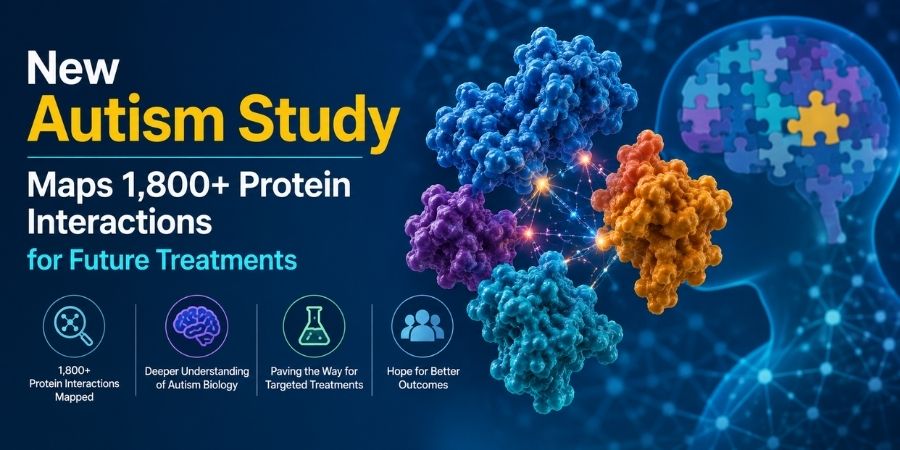
Scientists at the University of California, San Francisco (UCSF) have created what they describe as the largest molecular interaction map of autism to date. Published in Science on August 27, 2026, the study mapped more than 1,800 protein-protein interactions linked to 100 high-confidence autism risk genes. About 87% of those interactions had not been reported previously.
The findings could help researchers move toward more targeted therapies for some forms of autism. The study does not represent a new autism treatment available to patients today. Instead, it provides researchers with a much clearer picture of the molecular processes they may eventually be able to target with medicines.
What Did the New Autism Study Find?
For decades, researchers have identified genes associated with autism spectrum disorder. The challenge has been understanding what happens after a genetic mutation occurs.
The UCSF team focused on what those genes produce: proteins.
Researchers mapped how proteins interact with each other and then studied how specific mutations changed those interactions. They examined 54 patient-derived autism mutations and found that different mutations could produce similar disruptions in shared protein networks.
Key numbers from the study:
|
Finding |
Number |
|
Autism risk genes mapped |
100 |
|
Protein interactions identified |
1,800+ |
|
Previously unknown interactions |
87% |
|
Patient-derived mutations studied |
54 |
|
Research period |
More than 10 years |
|
People with profound autism potentially most directly relevant to the research |
About 30% |
The researchers used affinity purification-mass spectrometry (AP-MS) to study protein interactions. They also used structural modelling and experiments involving human forebrain organoids to investigate how mutations affected these molecular connections.
Why is this Important for Autism Treatment?
Autism is genetically complex.
Researchers have identified hundreds of genes associated with autism risk. If every mutation required a completely different medicine, developing treatments would be extremely difficult.
The new study points toward another possibility.
Instead of targeting every individual genetic mutation, researchers may be able to target shared protein complexes or molecular pathways affected by several different mutations.
That could eventually allow one treatment to address multiple genetic forms of autism.
UCSF researchers found that genetically different forms of autism can converge on some of the same protein complexes. The finding is particularly important because it identifies potential molecular targets that could be addressed with drugs.
From genes to potential treatments
The research process can be understood in four stages:
Genetic mutation → Protein change → Disrupted protein network → Potential drug target
This approach gives researchers more information about what happens between a genetic variant and changes in brain development.
The Study Used AI and Lab-Grown Brain Tissue
Artificial intelligence was one component of the research process.
Researchers applied structural modelling techniques, including the use of AlphaFold, to gain an understanding of protein structures and pinpoint mutation sites that might interfere with protein interaction by forming new or modifying existing interfaces. After that, to check if those changes actually had any effect on living organisms, the set up some biological experiments.
Human brain organoids also played a role.
These laboratory-grown models contain cells that can reproduce certain features of developing human brain tissue. They do not replicate the entire human brain, but they can provide researchers with a way to study particular biological processes.
The combination of genetic data, protein mapping, AI-based structural modelling and laboratory experiments gave researchers several ways to examine the same biological problem.
What are Protein-Protein Interactions?
Proteins inside cells work together.
A protein rarely operates completely independently. It can connect with other proteins to form complexes that perform specific functions.
When a genetic mutation changes one of those proteins, the effects can extend to its interactions with other proteins.
The UCSF research found that autism-associated mutations can rewire these protein networks, rather than simply switching one protein off.
This distinction could be important for future drug development.
A treatment may eventually need to restore or modify a disrupted interaction rather than simply replace or suppress a particular gene.
Could One Autism Drug Treat Multiple Genetic Forms?
That is one of the most interesting possibilities raised by the research.
The study found that different genetic mutations can affect common molecular networks. This creates the possibility of developing drugs that target these shared networks.
For example, researchers found that different mutations involving FOXP1 could converge on disruption of the same FOXP1-FOXP4 protein interaction. The study also identified convergence involving other autism-related proteins.
This does not mean that researchers have already developed such a medicine.
The discovery provides a potential direction for future research.
Potential advantages of targeting shared protein networks
- One treatment could potentially address multiple mutations.
- Researchers could focus on common biological mechanisms.
- Drug development could become more practical for genetically diverse conditions.
- Small-molecule medicines could offer advantages in manufacturing and delivery.
- Researchers could investigate specific protein interfaces as drug targets.
The researchers emphasise that substantial work remains before these findings can become clinical treatments.
Who Could Benefit from This Research?
The study is most directly relevant to people with profound autism, particularly individuals with rare, high-impact mutations in established autism risk genes.
UCSF researchers estimate that profound autism affects approximately 30% of people with autism, although definitions and estimates can vary depending on the population and criteria used.
The scientists are in particular curious about individuals with significant support needs because they expect to find rare genetic mutations more commonly in this group.
In contrast, the findings can’t be taken as a treatment for all sorts of autism.
Autism spans a very wide spectrum and its biology comprises a large number of genetic and developmental factors.
Is There a New Cure for Autism?
No.
The new study does not provide a cure for autism, and it does not introduce an approved treatment.
It identifies molecular mechanisms that could become targets for future therapies.
That distinction is important because research findings and clinical treatments are very different stages of the drug-development process.
Before a potential therapy can reach patients, researchers generally need to establish:
- Whether the target is biologically valid.
- Whether changing the target produces the intended effect.
- Whether a candidate drug is safe.
- Whether it works in appropriate animal or laboratory models.
- Whether it is safe in humans.
- Whether it produces meaningful clinical benefits.
- Whether those benefits outweigh potential risks.
The UCSF research is primarily advancing the target-discovery stage.
How Could This Change Precision Medicine for Autism?
Precision medicine aims to develop treatments based on the biological characteristics of an individual or subgroup rather than treating everyone with the same approach.
The new autism map could support this approach.
Researchers could potentially use genetic information to identify a particular mutation and then determine which protein network has been disrupted.
|
Traditional research question |
New approach |
|
Which gene is associated with autism? |
Which protein does the gene produce? |
|
What mutation is present? |
How does the mutation change protein interactions? |
|
Which gene should be targeted? |
Which molecular pathway is disrupted? |
|
Does one mutation require one treatment? |
Do multiple mutations affect the same target? |
|
Can symptoms be managed? |
Can specific biological mechanisms be targeted? |
This could eventually provide a more detailed way of developing therapies for genetically defined forms of autism.
$46 Million Investment Could Accelerate Autism Drug Research
The study has also been followed by a major research investment.
UCSF’s Quantitative Biosciences Institute received a $46 million grant from Aligning Research to Impact Autism (ARIA) to expand its research into the molecular mechanisms underlying autism.
The funding will support work focused on protein-protein interactions and potential therapeutic targets.
This is significant because moving from a molecular discovery to a medicine requires years of additional research, testing and investment.
The grant gives researchers additional resources to investigate whether the protein networks identified in the study can actually be targeted therapeutically.
What Are the Limitations of the New Autism Map?
The findings are important, but several limitations need to be considered.
The study does not explain every form of autism
Autism has many genetic and developmental pathways. The 100 high-confidence risk genes studied represent an important group, but they do not account for every factor associated with autism.
Laboratory models are different from patients
Protein experiments and brain organoids provide valuable information, but they cannot reproduce every aspect of human brain development or everyday behaviour.
Potential drug targets still require testing
Finding a disrupted protein interaction does not automatically mean that changing it will improve clinical outcomes.
Treatment development takes time
Even promising molecular targets can fail during drug development because of safety, effectiveness, delivery or manufacturing challenges.
For these reasons, families should view the research as a significant scientific development rather than as an immediate autism treatment.
Why this Research Matters Beyond Autism
The researchers believe the method could have applications beyond autism.
The basic framework is:
Genetic variation → Protein interactions → Disease mechanism → Drug target
That approach could potentially be applied to other complex diseases where researchers know which genes are involved but have difficulty connecting those genes to specific biological mechanisms.
UCSF researchers previously used protein-interaction mapping in COVID-19 research. According to UCSF, that work identified 69 potential drug candidates, with 27 advancing into clinical trials.
The autism project applies a similar research philosophy to a much more complex neurodevelopmental condition.
Frequently Asked Questions
What is the new autism molecular map?
It is a detailed map of protein-protein interactions associated with autism risk genes. UCSF researchers mapped more than 1,800 interactions involving 100 high-confidence autism risk genes.
What did scientists discover about autism genes?
Researchers found that different autism-associated mutations can disrupt common protein networks. This suggests that genetically different forms of autism may share some underlying molecular mechanisms.
Can autism be treated with a new drug based on this study?
No new autism drug is available because of this study. The research identifies potential therapeutic targets that require further testing.
Did researchers use AI in the autism study?
Yes. Structural modelling, including AlphaFold, was used alongside laboratory experiments to investigate how mutations affect protein interactions.
How many protein interactions were identified?
The researchers identified more than 1,800 protein-protein interactions, and about 87% had not previously been reported.
What is the $46 million autism research grant for?
The grant awarded to UCSF’s Quantitative Biosciences Institute will support further research into autism-related protein interactions and the development of potential precision therapies.
Key Takeaways
- Scientists at UCSF created the largest molecular map of autism to date.
- The study examined 100 high-confidence autism risk genes.
- Researchers identified more than 1,800 protein interactions.
- 87% of those interactions were previously unknown.
- The team studied 54 patient-derived autism mutations.
- Different mutations were found to disrupt some of the same protein networks.
- These shared networks could become targets for future precision autism treatments.
- AI-based structural modelling and brain organoid experiments supported the research.
- The work is particularly relevant to people with profound autism and rare, high-impact mutations.
- UCSF has received $46 million to expand this research.
- The study represents an important step in drug discovery, but it is not an autism cure or an approved treatment.
The Bigger Picture
The new autism study changes the level at which researchers can investigate the condition.
For years, scientists have built an increasingly detailed list of genes associated with autism. The UCSF research adds another layer by showing how proteins produced by those genes interact and how specific mutations can alter those relationships.
That information could help researchers identify biological targets shared by multiple genetic forms of autism.
The next stage is considerably harder: turning those targets into medicines that are safe, effective and useful for patients.
The 1,800-plus protein interactions, 54 patient-derived mutations and 100 high-confidence autism risk genes provide a substantial research foundation. The $46 million investment from ARIA gives the UCSF team additional resources to continue that work.
For now, the most accurate way to describe the development is this: scientists have built a much more detailed map of the molecular biology associated with autism, and that map may help guide the development of more targeted treatments in the years ahead.