
Two health stories are colliding this week in a way that says a lot about where American health care is headed: rising evidence that a common vaccine does more than anyone expected, and mounting proof that employers are pulling back on one of the most in-demand drug categories in decades.
Here’s what’s actually happening, and what it means if you’re on a GLP-1 drug or covered by an employer health plan.
Are Employers Really Dropping Coverage for GLP-1 Weight-Loss Drugs?
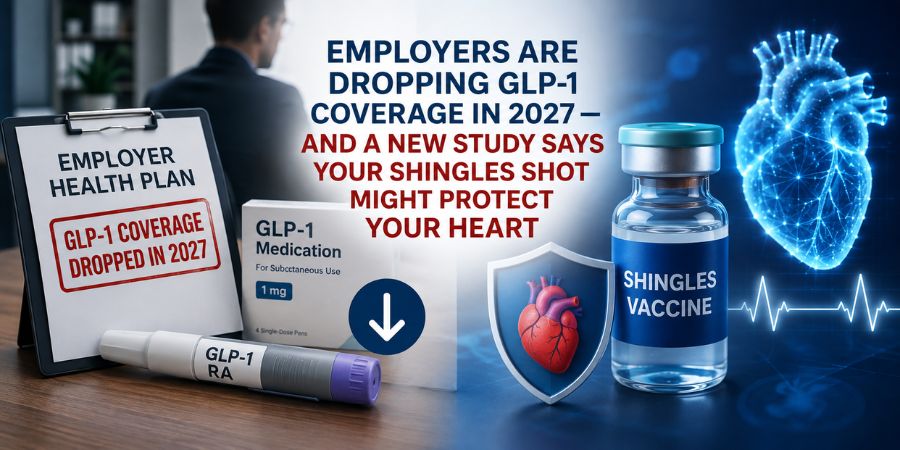
Yes. About 14% of U.S. employers have already dropped or plan to drop coverage of GLP-1 weight-loss drugs in 2027, according to a new survey from the Business Group on Health, as rising health care costs push companies to make harder choices about what they’ll pay for.
The share of employers covering GLP-1 drugs for weight loss fell from 72% in 2025 to 60% in 2026, and that number is expected to keep shrinking. Of the employers still covering these drugs, only 72% say they’re likely to continue that coverage into 2027, meaning even companies that currently offer the benefit aren’t guaranteed to keep it.
Pharmacy costs already make up a quarter of employer health care spending, and that line item is projected to rise another 12% in 2027. GLP-1 medications like Novo Nordisk’s Wegovy and Eli Lilly’s Zepbound are a big part of why: two-thirds of employers surveyed reported rising utilization of the drugs, even as they try to rein in who qualifies for coverage.
Why Are Companies Cutting GLP-1 Weight-Loss Drug Benefits?
Employers say the cost of covering GLP-1 drugs for weight management has become unsustainable, especially as more employees seek prescriptions and as an anticipated oral GLP-1 option threatens to push demand even higher.
Ellen Kelsay, president and CEO of the Business Group on Health, put it bluntly: this is “an unfortunate new reality for employers,” who are now facing genuine difficulty budgeting and forecasting their health plans a year out. Fully 87% of surveyed employers expect an oral version of these drugs to drive demand higher still, and almost none expect prices to come down on their own.
PepsiCo is one of the most visible examples. The company recently notified employees that weight-loss drug coverage will end in October, telling staff in an internal message that prescription weight-loss medications had become one of the fastest-growing costs in its health plan. Employees can still get the drugs, just not through their workplace insurance, and at full list price, which runs well over $1,000 a month for some brands.
It’s not just PepsiCo. Consulting firm Mercer has found that roughly 6% of large employers had already dropped GLP-1 coverage as of 2026, with more indicating plans to follow. Even health insurer Cigna has acknowledged a slowdown in prescription growth and coverage in recent earnings calls, a sign the weight-loss drug boom may be entering a more cautious phase after several years of explosive growth.
What Should Employees Do If Their Company Drops GLP-1 Coverage?
Ask HR about transition timelines, check whether the drug’s manufacturer offers a direct-purchase or savings program, and talk to your doctor about alternatives if cost becomes a barrier to continuing treatment.
Losing employer coverage doesn’t have to mean stopping treatment immediately. Some manufacturers have started offering cash-pay programs directly to patients, and pharmacy benefit managers have flagged that out-of-pocket options exist for people who lose insurance coverage. It’s worth checking those routes before assuming the cost is simply out of reach.
Does the Shingles Vaccine Actually Protect Against Heart Disease?
New research published in Nature Medicine found that people who received the newer, recombinant shingles vaccine (Shingrix) had meaningfully lower rates of cardiovascular disease than those who received the older vaccine, including a 10% reduction in coronary heart disease and a 12% reduction in heart failure.
Researchers from the University of Oxford used a clever “natural experiment,” comparing similar groups of people vaccinated just before and just after Shingrix replaced the older Zostavax vaccine in the U.S. in 2017. The recombinant vaccine group showed a 9% lower overall cardiovascular disease burden over roughly seven years of follow-up, with the strongest protective effect appearing in the first three and a half years after vaccination.
This builds on earlier findings from the same research team showing the shingles vaccine was also linked to a 17% lower risk of dementia. Separately, a study presented earlier this year at the American College of Cardiology’s annual meeting found people with existing heart disease who got a shingles vaccine had nearly half the rate of serious cardiac events within a year, compared with those who skipped it, a benefit researchers compared to the impact of quitting smoking.
Why Would a Shingles Vaccine Affect Heart Health?
Researchers believe a shingles infection can trigger inflammation and blood clots around the heart and brain, so preventing the infection in the first place may also help prevent those downstream cardiovascular complications.
It’s an association, not proof of direct cause and effect, these are observational studies, not randomized clinical trials, but a large registry-based trial now underway in Denmark aims to test the connection more rigorously. For now, the CDC’s existing guidance stands: adults 50 and older are recommended to get two doses of the shingles vaccine, a recommendation this emerging cardiovascular evidence only adds weight to.
Conclusion
Both stories point to the same underlying tension in U.S. health care right now: growing evidence for what keeps people healthy, running up against employers and insurers trying to control what they’re willing to pay for. Whether it’s a decades-old vaccine turning out to do more than expected, or a blockbuster weight-loss drug becoming too costly for companies to sustain, the coverage decisions being made this year will shape what treatment actually looks like, and who can afford it, in 2027 and beyond.