

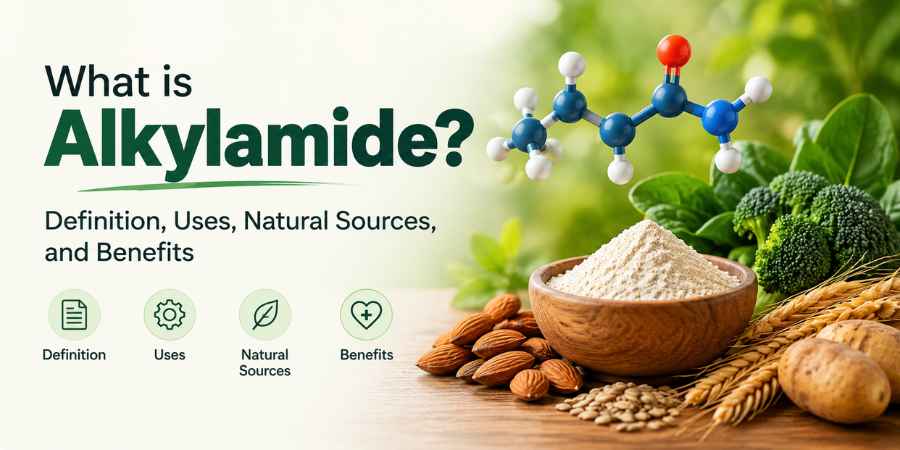
Look into Echinacea supplements and you’ll soon run into the word alkylamide. These plant compounds show up often in research, but a lab result doesn’t always carry over to a supplement.
So, it helps to know what they are, where they come from and what the evidence actually shows.
What is Alkylamide?
An alkylamide is an organic compound with an amide group inside a carbon-based structure. The term alkamide usually refers to the natural versions found in plants.
Alkylamides aren’t one chemical. They’re a family, and a small change in structure can change how a compound behaves. Echinacea is the best-known source, since it’s widely used in herbal products sold for colds. Most research on these compounds is still early-stage.
What is the Chemical Structure of Alkylamide?
The core is an amide group: a carbonyl bonded to nitrogen. In many natural alkamides, it links a fatty-acid chain to an amine.
The chain can be short or long and may contain double or triple bonds. Many plant alkamides are also lipophilic, meaning they are drawn to fats and oils, which affects how they are extracted and how they cross cell membranes.
The mix of alkamides also varies between Echinacea species and preparations, so two extracts can behave differently. That’s why chemical analysis matters: you need to know which compounds are present and how much.
Where Are Alkylamides Found Naturally?
- Echinacea: Echinacea purpurea and Echinacea angustifolia are the most studied sources. Two products labelled “Echinacea” can contain very different amounts, so results from one can’t be applied to another.
- Black pepper and other Piper species: They contain some alkamides, but that doesn’t mean every pepper compound has the same effects.
- Sichuan pepper: Zanthoxylum species contain the alkamides behind its tingling, mouth-numbing feel.
- Toothache plant: Acmella contains spilanthol, which causes a strong buzzing sensation. A noticeable sensation isn’t proof that a product treats any condition.
What Are Alkylamides Used For?
- Herbal products: Echinacea extracts contain alkamides alongside other substances.
- Pharmaceutical research: Some compounds are being studied for anti-inflammatory, antimicrobial and pain-related effects. None of this shows a supplement can treat those conditions.
- Cosmetics: Spilanthol is being explored for topical products because of its sensory properties.
- Food science: Some alkamides create the tingle or numbness of certain spices.
These uses are at different stages. A compound can be useful in research and still be far from a medicine or product.
What Does Scientific Research Say About Alkylamide Benefits?
- Anti-inflammatory effects: Some alkamides are active in lab studies on inflammation. It’s not yet known whether the same happens in people at safe doses.
- Immune effects: Some Echinacea alkamides interact with immune cells. This is called immunomodulatory activity, and it doesn’t simply mean “boosting immunity.”
- Sensory and pain effects: Tingling and numbing make alkamides interesting for study, but a sensory effect isn’t proven pain relief.
What Echinacea research can and can’t tell us: The US National Center for Complementary and Integrative Health (NCCIH) reports that some Echinacea products may slightly reduce the chance of catching a cold. It’s unclear whether they shorten a cold, and results vary by product. These findings are about whole Echinacea preparations, not isolated alkylamides, so they can’t show that alkylamides alone are responsible.
Are There Any Safety Concerns Associated with Alkylamides?
Safety depends on the compound, dose and preparation. Echinacea products can cause digestive upset and allergic reactions, which can be serious in people sensitive to related plants. They may also interact with medicines.
Check the ingredient list, and talk to a professional if you take prescription medication, have a health condition, are pregnant or are breastfeeding. Safety findings for one preparation shouldn’t be applied to another.
Frequently Asked Questions
Is alkylamide a single chemical?
No. It’s a group of related compounds, each with its own properties and effects.
Are alkylamides found in Echinacea?
Yes. The amount depends on the species, plant part and extraction method.
Do alkylamides boost the immune system?
Some affect immune pathways in experiments, but that doesn’t prove they improve immunity or prevent illness in people.
Are alkylamides safe to consume?
It depends on the compound and preparation. Echinacea can cause digestive upset or allergic reactions in some people. If you take medication, ask a professional first.
What is the difference between alkylamides and fatty acid amides?
They overlap, but aren’t interchangeable. Fatty acid amides come from fatty acids and amines, while plant alkamides are a related group of natural compounds.
Conclusion
Alkylamides occur in Echinacea, certain peppers and the toothache plant. Early findings hint at anti-inflammatory, immune-related and sensory effects, but the evidence doesn’t support treating them as one ingredient with proven health benefits. When researching herbal products, check what’s actually been shown for the specific substance.
Key Takeaways from the Author
- Alkylamides are a family of related compounds, not one chemical.
- Echinacea, some Piper and Zanthoxylum species, and the toothache plant are natural sources.
- Many suggested health benefits still need confirmation in humans.
- Findings on Echinacea extracts don’t prove the effects of isolated alkylamides.
- Safety depends on the product’s composition, dose, preparation and the person using it.