
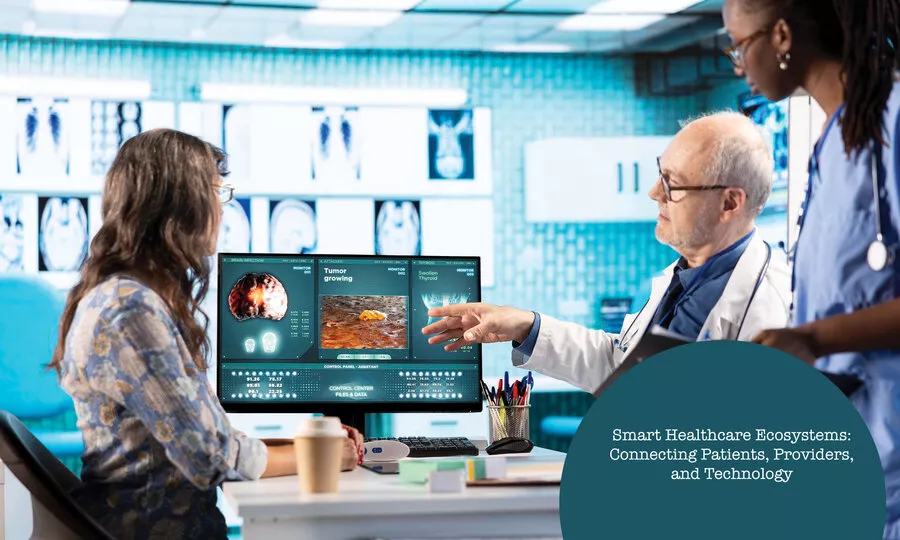
Healthcare is no longer confined to hospitals, clinics, or doctors’ offices. It has evolved into a connected ecosystem where patients, healthcare providers, medical technologies, insurers, pharmacies, and research institutions work together through digital platforms to deliver more coordinated and efficient care. This transformation is redefining how healthcare is accessed, managed, and experienced, creating a future where information moves seamlessly, decisions are made faster, and patient outcomes continue to improve.
A smart healthcare ecosystem is built on connectivity. Rather than treating healthcare as a series of isolated interactions, it creates a unified network where data, technology, and clinical expertise come together to support every stage of the patient journey. From preventive care and diagnosis to treatment, recovery, and long-term health management, digital integration enables healthcare professionals to deliver personalized care while empowering patients to become active participants in their own well-being.
Breaking Down Traditional Barriers
For decades, healthcare systems have struggled with fragmented information. Patient records often remained within individual hospitals or clinics, making it difficult for specialists, primary care physicians, laboratories, and pharmacies to access the same information. This fragmentation frequently resulted in duplicated tests, delayed diagnoses, inconsistent treatment plans, and unnecessary administrative complexity.
Smart healthcare ecosystems address these challenges by creating interoperable digital networks that allow secure information sharing across multiple healthcare providers. Electronic health records serve as the foundation of this connectivity, ensuring that authorized professionals have access to complete and up-to-date patient information whenever and wherever it is needed.
The result is greater continuity of care. Patients no longer need to repeatedly explain their medical history or carry physical records between providers. Clinicians can collaborate more effectively, leading to faster diagnoses, more accurate treatment decisions, and improved coordination across the healthcare system.
Empowering Patients Through Digital Engagement
One of the defining characteristics of modern healthcare ecosystems is the shift toward patient empowerment. Digital technologies are giving individuals greater visibility into their own health while making healthcare services more accessible than ever before.
Mobile health applications, patient portals, wearable devices, and telemedicine platforms enable patients to schedule appointments, access medical records, communicate with healthcare professionals, review test results, monitor chronic conditions, and receive personalized health recommendations from virtually anywhere.
Wearable technologies continuously collect valuable health information such as heart rate, blood pressure, sleep quality, physical activity, and glucose levels. This real-time data helps patients better understand their health while providing clinicians with valuable insights that support earlier intervention when necessary.
Instead of interacting with healthcare only during illness, individuals are increasingly able to monitor their health proactively, encouraging preventive care and healthier lifestyle choices.
Strengthening Clinical Decision Making
Increasing availability of health care data is changing the way clinicians make decisions. Smart ecosystems bring together information from electronic health records, diagnostic imaging, laboratory systems, wearable devices, genomic data, and clinical research onto unified platforms that provide clinicians with a complete view of each patient’s condition.
Artificial intelligence and advanced analytics further this ability to uncover hidden patterns, anticipate potential complications, and guide evidence-based treatment decisions. Physicians are able to quickly evaluate risk factors, treatment options, and develop treatment plans based on individual patients and overall clinical knowledge.
Far from replacing medical expertise, these technologies serve as intelligent support systems that improve clinical accuracy and reduce human error. The decisions are still made by healthcare professionals, supported by ever more sophisticated digital tools.
Building Secure and Trusted Digital Healthcare
As health care becomes more interconnected, safeguarding patient information remains a top priority. Smart healthcare ecosystems generate large volumes of sensitive medical data that require strong cybersecurity measures to ensure confidentiality, integrity, and availability.
To protect their digital infrastructure from increasing cyber risks, healthcare organizations are investing in advanced encryption, multi-factor authentication, cloud security, identity management, and continuous threat monitoring. Clear governance policies are also paramount to ensure patient data is collected, shared, and used responsibly.
Public trust must be earned through transparency in the use of personal health information, and a commitment to ensuring that technological innovation is always in the service of patient privacy and ethical standards.
A Foundation for the Future of Healthcare
The future of healthcare will be defined not by individual technologies, but by how well they work together in connected ecosystems.” The integration of artificial intelligence, precision medicine, robotics, digital diagnostics, wearable technologies, and predictive analytics will continue to drive the emergence of increasingly proactive, personalized, and efficient healthcare systems.
As these ecosystems evolve, the focus will shift from treating disease to long-term wellness. Ongoing monitoring, preventive interventions, personalized treatment strategies, and coordinated care will improve quality of life while reducing the overall burden on healthcare systems.
Smart healthcare ecosystems ultimately provide a new approach to healthcare delivery, one that views patients, providers, and technology as working together as connected partners. These ecosystems are laying the groundwork for a more accessible, resilient, and patient-centered future by fostering collaboration, enabling informed decision-making, and broadening care outside of traditional clinical settings. “Technology is a powerful enabler to enhance relationships, improve outcomes, and make sure quality healthcare is available whenever and wherever it’s needed. In this connected world, technology is not replacing human care.”