

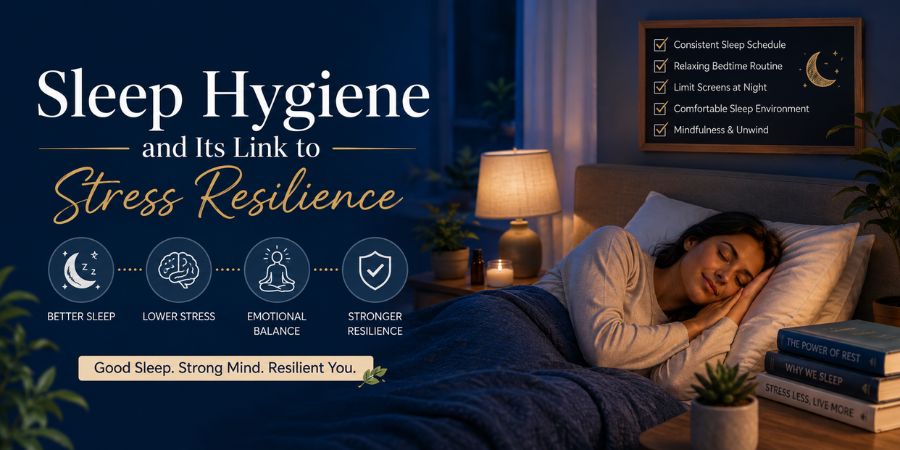
A stressful day can follow you into bed. You replay conversations, think about tomorrow’s workload, check your phone one more time, and suddenly an hour has passed. Then you wake up tired and discover that the problem that felt manageable yesterday seems much harder today.
That is where sleep hygiene and stress resilience intersect.
Sleep does not remove the source of stress, but it affects how well the brain and body respond to it. A large systematic review and meta-analysis covering 154 studies and 5,717 participants found that different forms of sleep loss reduced positive mood and increased anxiety symptoms.
Good sleep hygiene is therefore less about following a perfect bedtime routine and more about protecting the conditions that allow sleep to do its job.
What is Sleep Hygiene?
Sleep hygiene means the everyday habits and bedroom conditions that support consistent, good-quality sleep.
There is actually no single universally agreed definition of sleep hygiene. A 2024 review examined 548 adult studies and found that researchers commonly looked at factors such as caffeine, alcohol, exercise, sleep timing, light, naps, noise, temperature and bedtime routines.
In practical terms, good sleep hygiene usually means:
- Going to bed and waking up at roughly the same time.
- Getting enough time for sleep.
- Keeping the bedroom dark, quiet and comfortably cool.
- Getting natural light during the day.
- Exercising regularly.
- Limiting caffeine later in the day.
- Avoiding heavy meals and alcohol close to bedtime.
- Reducing stimulating screen use before bed.
- Creating a short period to slow down before sleeping.
These are simple habits, but consistency matters more than creating an elaborate nighttime ritual.
How is Sleep Connected to Stress Resilience?
Sleep supports some of the mental and emotional functions that help people deal with stress.
If sleep gets consistently cut short or disrupted, then regulating emotions becomes a challenge. It is found in the extensive meta-analysis which involved 154 studies that sleep deprivation led to fewer feelings of happiness while at the same time increasing symptoms of anxiety. In general, sleep disturbance was linked to weaker emotional reactivity to stimuli.
That helps explain a familiar experience: after a poor night’s sleep, a minor problem can feel disproportionately irritating or overwhelming.
It does not mean that every stressful reaction is caused by lack of sleep. Work pressure, relationships, finances, health and other circumstances still matter. Sleep is one part of the picture.
How Much Sleep Do Adults Need?
Most adults need at least seven hours of sleep each night.
The CDC recommends seven or more hours for adults aged 18 to 60, while adults aged 61–64 generally need 7–9 hours and those 65 and older need 7–8 hours.
Yet short sleep is common. CDC data show that 35% of U.S. adults reported getting fewer than seven hours of sleep in 2020.
For stress resilience, the point is not to chase a particular number at all costs. Sleep needs vary between people. The bigger concern is regularly getting too little sleep or waking frequently without feeling refreshed.
Why Does Sleep Quality Matter as Much as Sleep Duration?
Imagine spending eight hours in bed but waking repeatedly throughout the night. The clock says eight hours, but the experience may be very different from eight hours of relatively uninterrupted sleep.
The CDC describes quality sleep as uninterrupted and refreshing sleep, not simply time spent in bed.
This distinction is important when thinking about stress resilience. Someone may technically meet a sleep-duration target and still feel exhausted if their sleep is fragmented.
Useful questions to ask are:
- Do I usually wake feeling rested?
- Do I wake repeatedly during the night?
- Am I sleepy during the day?
- Does my sleep schedule change dramatically on weekends?
- Do I rely heavily on caffeine to get through the day?
These can tell you more about your sleep than the number of hours alone.
Can a Consistent Sleep Schedule Make a Difference?
Yes. Keeping a relatively consistent bedtime and wake time is one of the simplest sleep-hygiene habits to try.
The CDC recommends going to bed and getting up at the same time each day, including weekends.
That does not mean you need to go to bed at exactly 10:00 p.m. every night. A more realistic approach is to keep your schedule within a fairly consistent range.
For example:
Instead of: Sleeping at 11 p.m. on weekdays, 2 a.m. on Friday and 3 a.m. on Saturday.
Try: Keeping your bedtime and wake time within a narrower window throughout the week.
A predictable rhythm can make it easier to plan enough time for sleep rather than treating sleep as whatever is left after everything else is finished.
What Should You Do During the Day to Sleep Better at Night?
Sleep hygiene really begins before bedtime.
The CDC advises a person to take in some sun, mainly during the morning, do some exercise and get enough sleep regularly.
A normal daytime schedule could be:
- Morning: do some sun bath.
- Work time: Don’t be a regular seat potato – keep moving
- Afternoon: Pay attention to your caffeine intake, if you suffer from insomnia
- Evening: Decrease any hard or exciting activities
- Night: Prepare your bed for sleep.
One of the places where sleep hygiene is really useful without being hard is here. You aren’t trying to “cheat” on sleep. You are simply letting your body know when it is time to be awake and when it is time for sleep by giving it the right signals.
Does Your Bedroom Really Matter?
Yes. The sleep environment can make it easier or harder to stay asleep.
The CDC recommends a bedroom that is quiet, relaxing and cool, along with reducing electronic-device use before bedtime.
If your room is uncomfortable, you do not necessarily need expensive sleep products. Start with the basics:
- Reduce unnecessary noise.
- Block excessive light.
- Keep the temperature comfortable.
- Put your phone somewhere that reduces the temptation to check it.
- Keep work materials away from the bed when possible.
The goal is a bedroom that does not constantly remind your brain that it is time to work, scroll or solve problems.
What About Phones and Screens Before Bed?
Reducing electronic-device use before bedtime is a reasonable part of sleep hygiene, particularly if screens keep you mentally engaged.
The CDC recommends turning off electronic devices at least 30 minutes before bedtime.
The issue is not simply that a phone is inherently harmful to sleep. A late-night screen session can also mean bright light, emotional stimulation, work messages, social media and the loss of 30 minutes that could have been spent sleeping.
Try replacing the final part of the evening with something quieter:
- Reading a physical book
- Listening to calm music
- Taking a warm shower
- Stretching gently
- Preparing for the next morning
- Writing down tomorrow’s tasks
The last option can be particularly useful when unfinished tasks keep running through your mind.
Can Better Sleep Make You More Resilient to Stress?
Better sleep is associated with better emotional functioning, but sleep hygiene should not be presented as a guaranteed way to become more resilient.
Research shows a strong relationship between sleep and emotional health, but resilience is influenced by much more than sleep. Social support, coping skills, physical health, working conditions and life circumstances all matter.
What the research does make clear is that sleep loss can affect emotional functioning. The 154-study meta-analysis found that sleep deprivation, sleep restriction and fragmented sleep all had measurable effects on emotional outcomes.
So, the useful question is not, “Will sleeping well solve my stress?”
It is: “Am I making stress harder to handle by consistently sacrificing sleep?”
For many people, that is a much more practical question.
What is the Best Sleep Routine for Stressful Periods?
You do not need a complicated routine. Start with the habits that are easiest to maintain.
During the day
- Get some natural daylight.
- Stay physically active.
- Keep caffeine earlier if it interferes with sleep.
- Avoid relying on long naps to compensate for chronic short sleep.
One hour before bed
- Finish work where possible.
- Reduce stimulating conversations and content.
- Dim the environment.
- Put tomorrow’s important tasks on paper.
At bedtime
- Keep the room cool, dark and quiet.
- Put the phone away if it encourages scrolling.
- Go to bed around your usual time.
If your mind is racing
Try writing a short “tomorrow list.”
For example:
Call the doctor.
Send the report.
Buy groceries.
Reply to the email.
You are not solving the problems at midnight. You are simply giving your brain a place to store them until tomorrow.
Is Sleep Hygiene Enough for Chronic Insomnia?
No. Sleep hygiene can support healthy sleep, but it is not considered a stand-alone treatment for chronic insomnia.
The American Academy of Sleep Medicine recommends against using sleep hygiene as the only treatment for chronic insomnia because evidence suggests that other behavioural approaches can be more effective.
That distinction is often missed in wellness advice.
If someone regularly struggles to fall asleep, wakes for long periods during the night, wakes too early or experiences persistent daytime impairment, simply buying better bedding or turning off their phone may not address the underlying problem. A healthcare professional can help determine whether insomnia or another sleep disorder is involved.
The Bigger Connection Between Sleep and Stress
Sleep hygiene is sometimes reduced to a checklist: no caffeine, no screens, same bedtime, dark room.
The more useful way to look at it is as protecting recovery.
A difficult day can raise stress. Stress can interfere with sleep. Poor sleep can then affect mood and emotional regulation the following day. Research on sleep loss shows that this last part is not merely anecdotal; experimental studies consistently demonstrate effects on emotional functioning.
That does not mean you need perfect sleep to cope with life.
It means that when life becomes stressful, sleep is one of the things worth protecting rather than sacrificing first.
And if your sleep remains poor despite making reasonable changes, that is useful information too. Persistent sleep problems deserve attention rather than being dismissed as something you simply need to “try harder” to fix.