

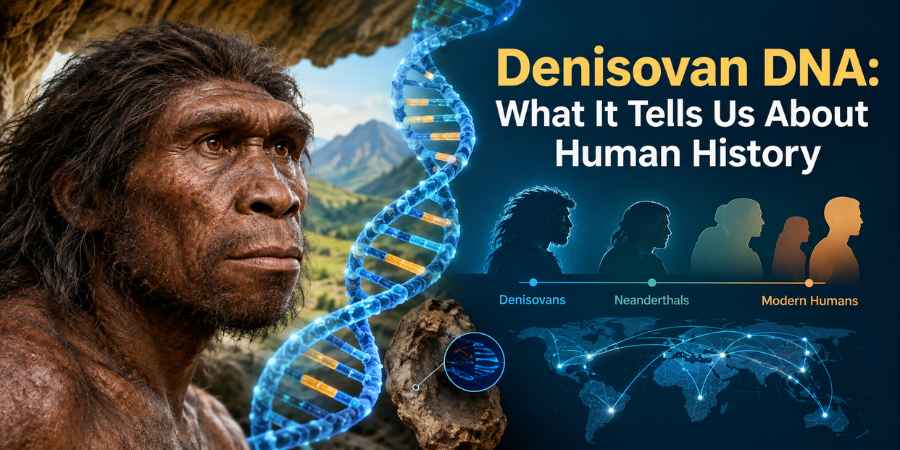
For more than a century, the story of human evolution was reconstructed mainly from bones, teeth and archaeological remains. The discovery of Denisovan DNA changed that approach. In 2010, researchers identified an unknown ancient human population from a tiny finger bone found in Denisova Cave in Siberia, using its DNA rather than its anatomy to recognize a previously unknown branch of the human family.
In time, the genetic evidence has uncovered something even more profound, that these ancient humans didn’t vanish, but instead genetically mingled with ancestors of some of today’s people, their DNA detectable in the populations that still reside in Asia and Oceania. Valuable new discoveries in fossil and protein remains in 2025 and 2026 are helping to complete this physical story.
What is a Denisovan?
A Denisovan is an extinct population or group of ancient humans closely related to Neanderthals and modern humans. The group was first identified through DNA from remains discovered in Denisova Cave in the Altai Mountains of Siberia.
The scientific classification remains an active area of research. Some researchers have associated Denisovan fossils with Homo longi, while another 2024 proposal grouped Denisova Cave, Xiahe and Penghu material within Homo juluensis. These taxonomic proposals are not universally settled.
Denisovan meaning: It therefore refers primarily to an ancient human group identified through remains from Denisova Cave, rather than to a universally agreed formal species name.
Denisovan facts at a glance
|
Fact |
What researchers know |
|
First identified |
2010 |
|
Key discovery site |
Denisova Cave, Siberia |
|
Close relatives |
Neanderthals and modern humans |
|
Fossil record |
Extremely limited but expanding |
|
Geographic evidence |
Siberia, Tibetan Plateau, Taiwan, China and Southeast Asia |
|
Genetic legacy |
Present in some populations in Asia and Oceania |
|
Exact height |
Still uncertain |
How did scientists discover Denisovan DNA?
Initial discovery was of a tiny finger bone from Dennisova Cave. They extracted mitochondrial DNA, which distinguished it from modern humans and other types of Neanderthals. Nuclear DNA later established the individual represented a new group of humans, who were closer to Neanderthals than to modern humans.
The breakthrough was remarkable because the initial identification did not depend on a distinctive skeleton or skull. Scientists had essentially discovered a human population through its genetic signature.
A high-quality genome was subsequently produced from less than 10 milligrams of material from the finger bone, providing an unusually detailed view of an extinct human population.
What does Denisovan DNA tell us about human history?
The biggest contribution of Denisovan DNA is evidence that human evolution involved repeated contact and genetic exchange among different human populations.
Modern human genomes also have regions derived from Denisovans. A study published in Nature Genetics in 2024 showed evidence for at least three separate events of Denisovan admixture from genetically distinct Denisovan groups.
This suggests that the ancient population was not a single isolated community living only around Siberia. Instead, Denisovans appear to have comprised several genetically differentiated groups spread across a large part of Asia.
Researchers have also used their genetic legacy to reconstruct ancient movements. Denisovan-related ancestry is particularly prominent in some populations in Island Southeast Asia and Oceania, showing that interactions between modern humans and Denisovan populations occurred far beyond the original Siberian discovery site.
One of the clearest examples: high-altitude adaptation
A particularly important genetic clue involves the EPAS1 gene.
Tibetan populations have a unique haplotype of EPAS1 gene that is known to adapt to hypoxic environment at high altitude. A study in Nature suggested that the Ancient DNA observations are incompatible with an in situ origin of these variants and point to introgression from Denisovan or Denisovan-related populations.
This is an important example of ancient DNA affecting the biology of people living today. A genetic variant acquired through ancient interbreeding appears to have helped modern humans adapt to one of Earth’s most demanding environments.
Where did Denisovans live?
The fossil record now points to a much wider geographic distribution than the original Siberian discovery suggested.
Evidence has been identified in:
- Denisova Cave, Siberia: the original genetic evidence.
- Baishiya Karst Cave, Tibetan Plateau: a Denisovan mandible and sedimentary DNA indicate occupation from at least about 160,000 years ago to around 60,000 years ago, with evidence possibly extending to about 45,000 years ago.
- Taiwan: ancient protein analysis identified the Penghu mandible as Denisovan in 2025.
- Northeastern China: protein analysis of the Harbin cranium in 2025 provided evidence linking the skull to Denisovans.
- Southwestern China: a 2026 Nature study identified five Denisovan remains at Bianfu Cave, including two parietal fragments, a radial fragment and two teeth, dated to approximately 167,000–134,000 years ago.
The 2026 Bianfu Cave discovery is particularly useful because it fills a geographic gap between previously known Denisovan sites and the populations in Southeast Asia and Oceania that carry Denisovan ancestry.
What do we know about Denisovan appearance?
For years, a Denisovan reconstruction was largely speculative because scientists had so few identifiable bones.
That changed substantially in 2025, when researchers analyzed proteins preserved in the nearly complete Harbin cranium. The skull, dated to at least 146,000 years ago, had previously been assigned to Homo longi. Protein evidence showed Denisovan-related amino-acid variants and placed the individual close to the Denisova genome.
The Harbin skull has a large braincase and prominent brow ridges. Combined with the Xiahe mandible and other remains, the evidence points toward a robust ancient human with substantial jaws and large teeth.
The picture is still incomplete. Researchers do not yet have a complete Denisovan skeleton, so characteristics such as average body proportions, muscle distribution and facial variation remain uncertain.
How tall were Denisovans?
There is no scientifically established average Denisovan height.
The reason is straightforward: researchers still lack the complete long bones needed to calculate stature reliably across the population. The Natural History Museum currently lists Denisovan height and weight as unknown for this reason.
That could change quickly. A 2026 preprint reported Denisovan-associated femur and tibia fossils from the Penghu Channel in Taiwan. The researchers estimated statures of approximately 180 cm and 190 cm for two individuals, with estimated body masses of about 83 kg and 91 kg. Because this work is currently a preprint rather than an established peer-reviewed result, these figures should be treated as provisional rather than as the population’s average.
This emerging evidence suggests that at least some Denisovans were large-bodied, but it would be premature to assign a single typical height to the entire group.
How are Denisovans different from Homo floresiensis?
The comparison with Homo floresiensis is useful because both groups show how diverse human evolution was in Asia.
|
Feature |
Denisovans |
Homo floresiensis |
|
Main evidence |
DNA, proteins and fragmentary fossils |
Multiple skeletons and fossils |
|
Major known region |
Eastern and Central Asia |
Flores, Indonesia |
|
Body size |
Still uncertain |
About 106 cm for the LB1 female estimate |
|
Genetic evidence |
Extensive DNA from Denisovan remains and modern humans |
No DNA recovered so far |
|
Relationship to modern humans |
Close archaic relative |
Distinct Homo lineage |
Smithsonian research estimates the female LB1 specimen of Homo floresiensis at about 106 cm tall. Fossils from Flores date broadly to around 100,000–60,000 years ago, while associated stone tools are older.
The contrast highlights an important point: Asia was home to several different human lineages at overlapping times. Denisovans were not simply another name for Homo floresiensis, and there is currently no evidence that the two groups were the same population.
What has changed in Denisovan research in 2025 and 2026?
The field has moved from genetics toward a combination of DNA, ancient proteins, fossils and archaeology.
Three developments stand out:
- The Harbin cranium: Protein analysis linked the large Chinese skull to Denisovan ancestry, providing a much better basis for understanding their physical appearance.
- The Penghu mandible: Protein analysis identified a Taiwanese fossil as Denisovan, extending the known fossil distribution into the Taiwan region.
- Bianfu Cave: The 2026 discovery in southwestern China produced multiple Denisovan bones and teeth, giving researchers new evidence about anatomy and geographic distribution.
The archaeological evidence is expanding as well. Recent work at a cave site in southwestern China indicates Denisovans hunted animals such as deer and used simple bone tools, offering evidence about behavior rather than genetics alone.
What remains unknown?
The Denisovan story is still incomplete. Scientists do not yet know:
- Exactly how many Denisovan populations existed across Asia.
- How genetically different those populations were from one another.
- Their full physical range of variation.
- Their average body size or Denisovan height.
- Precisely when their populations disappeared.
- How their technology and behavior varied between regions.
- Whether additional Asian fossils currently assigned to other Homo groups will eventually prove to be Denisovan-related.
The continuing scarcity of fossils is one reason DNA and protein analysis have become so important. Ancient proteins can survive where DNA does not, allowing researchers to identify fossils that would otherwise remain difficult to classify.
The larger lesson from Denisovan DNA
Denisovan research has changed the image of human evolution from a simple succession of species into a network of populations that moved, separated, met and sometimes interbred.
A single finger bone revealed an unknown human lineage. Genetic traces then connected that lineage to people living thousands of kilometres away. Fossils in Tibet, Taiwan and China are now giving that genetic story a physical geography.
The latest discoveries also show why the story remains open. As more Asian fossils are tested with ancient DNA and proteomics, the boundaries between named Homo groups may be revised. For now, Denisovan DNA provides one of the clearest records of how ancient human populations interacted, and how those encounters remain written into human genomes today.