
Measles exposure sites in Michigan are the public locations where health officials have confirmed that a person with measles may have spread the virus to others. The newest sites are in St. Joseph County, where two confirmed cases in November led to exposure notices for an urgent care clinic and a hospital emergency department waiting area. These cases add to a year in which the state has recorded infections across multiple counties. Residents need to know three things: where exposure may have occurred, which early symptoms to watch for, and whether their measles vaccination is up to date.
Where Were the Latest Measles Exposure Sites in Michigan?
A measles exposure site is a location where an infectious person spent time and other people may have breathed the same air. The Branch-Hillsdale-St. Joseph Community Health Agency confirmed two measles cases among St. Joseph County residents in November and named two such locations.
According to the agency’s November 9 announcement, the potential exposure locations were:
| Location | Date | Time window |
| WellNow Urgent Care, Sturgis | November 2 | 1:15 p.m. to 5 p.m. |
| Three Rivers Health emergency department waiting area | November 5 | 1:30 p.m. to 4:30 p.m. |
People who visited either location during these windows and are not vaccinated against measles have been advised to contact the health agency at 269-273-2161, extension 241. Officials recommend monitoring for symptoms for 21 days after a possible exposure.
The 21-day period translates into specific dates. Counting from the exposure dates in the announcement, monitoring runs through November 23 for the Sturgis visit and November 26 for the Three Rivers Health visit. The CDC states that symptoms usually appear seven to 14 days after exposure, which places the most likely symptom window between November 9 and 16 for the first site and between November 12 and 19 for the second. Anyone who visited either site is therefore still inside the monitoring period.
Healthcare locations carry added risk because they gather people with very different health needs. Infants too young for routine vaccination, pregnant women without immunity and people with weakened immune systems can develop serious complications if infected.
The two St. Joseph County cases also show why a healthcare facility needs advance notice of a suspected measles infection. A phone call before arrival lets staff arrange a separate entrance or room, which lowers the chance of exposing other patients and healthcare workers.
What is Driving Measles Concerns Across Michigan?
Measles concern in Michigan comes from a series of confirmed cases in several counties during the same autumn, not from a single event.
- Hillsdale County: Two residents were diagnosed in late October. Hillsdale Hospital then introduced mask requirements for patients and visitors at its birthing centre and an OB-GYN clinic.
- Sanilac County: The county confirmed its first measles case in years on October 29.
- Delta County: Three cases were reported in October, the first confirmed infections in that Upper Peninsula county since 1989.
- St. Joseph County: Two cases were confirmed in November, with the exposure sites listed above.
The available reports do not establish that these cases are connected, and health authorities are still investigating each one. Separate counties reporting cases within weeks of each other still shows why surveillance matters even when the cases look geographically unrelated. The hospital response in Hillsdale County is also worth noting: it protected the patients most at risk, which are newborns and pregnant women, rather than waiting for a wider outbreak to develop.
The Michigan Department of Health and Human Services maintains a measles updates page where residents can find official information on reported infections and public health announcements.
What Are the Early Symptoms of Measles?
Measles is a highly contagious viral illness that begins with fever and respiratory symptoms and is followed by a distinctive rash. Recognising the early signs matters because an infected person can spread the virus before the rash appears. The CDC describes the contagious period as beginning about four days before the rash and lasting about four days after it.
According to the CDC, symptoms generally develop seven to 14 days after exposure, although the incubation period can extend to 21 days.
Early warning signs include:
- High fever, which can exceed 104°F
- Persistent cough
- Runny nose
- Red, watery eyes
- Tiny white spots inside the mouth, known as Koplik spots
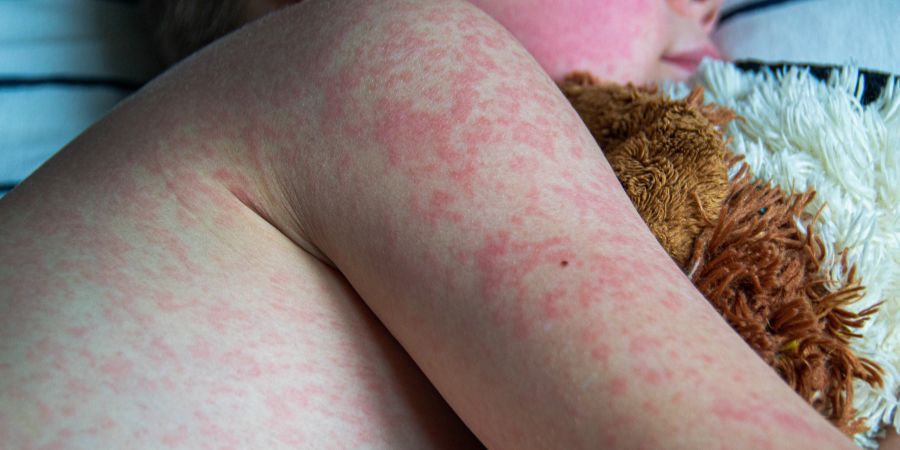
A red rash generally develops three to five days after the first symptoms. It usually starts on the face and spreads downwards across the body.
Measles spreads through the air when an infected person breathes, coughs or sneezes. The virus can remain infectious in the air for up to two hours after an infected person has left an enclosed space, which is why a short visit to a waiting room can count as an exposure.
Anyone who suspects an infection should stay home and contact a healthcare provider before visiting a clinic or hospital. This gives medical staff time to arrange precautions.
How Effective is the MMR Vaccine Against Measles?
The measles, mumps and rubella (MMR) vaccine is a combined vaccine that protects against three viral diseases. It is the most effective way to prevent measles and limit its spread.
The routine childhood immunisation schedule in the United States uses two doses. According to the CDC, one dose is approximately 93% effective against measles, and two doses provide approximately 97% protection. The first dose is generally recommended between 12 and 15 months of age, and the second between four and six years.
| Doses received | Approximate protection against measles |
| One | 93% |
| Two | 97% |
The four-point gain from the second dose looks small, but it matters at community level. Among 1,000 exposed people, 70 with one dose would still be susceptible, compared with 30 with two doses.
People who are uncertain about their vaccination history should consult a healthcare professional. Recommendations differ by age, previous doses, medical history and possible exposure. Vaccination also protects people who cannot receive the vaccine or who have not yet developed immunity.
What Should Michigan Residents Do After Possible Measles Exposure?
Anyone who believes they encountered measles should contact their local health department or healthcare provider promptly, even if they feel well. For the St. Joseph County sites, unvaccinated individuals have been asked to call the Branch-Hillsdale-St. Joseph Community Health Agency and monitor for symptoms for 21 days.
Time matters for preventive treatment. The CDC states that MMR vaccine given within 72 hours of exposure, or immune globulin given within six days, can prevent or reduce illness in some people. Those windows have closed for both St. Joseph County sites as of November 14, but a health agency can still assess individual cases, and vaccination still protects against future exposure.
Further precautions include:
- Call ahead before visiting any healthcare facility if measles exposure or infection is suspected.
- Watch for fever, cough, runny nose, red eyes and the characteristic rash.
- Avoid contact with infants, pregnant women and people with weakened immune systems.
- Check personal and family MMR vaccination records.
- Follow instructions from local public health authorities on testing and monitoring.
The CDC’s latest national update, published November 13, reported 5,412 confirmed measles cases across the United States in 2026, with 96% associated with outbreaks. Michigan is among the jurisdictions reporting infections.
For Michigan, the rise in confirmed cases points to three practical priorities: current vaccination records, prompt reporting of symptoms and careful use of healthcare facilities. The next task for public health officials is to identify transmission early and prevent further infections in communities where immunity may be limited.