

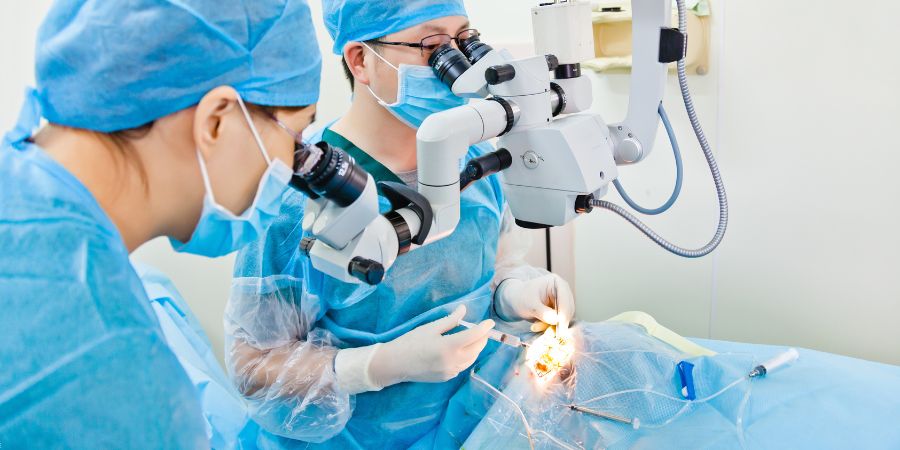
Cataract surgery is one of the most common procedures Medicare covers. Most patients expect to pay a few hundred dollars out of pocket. A growing number are walking out having paid several thousand, and the financial pressure driving that shift is coming from the doctors’ side of the equation, not the patients.
Medicare currently pays doctors about $520 for a standard cataract procedure, a figure that has fallen roughly 20% over the past decade. That fee covers the surgery itself plus pre- and post-operative visits. As that reimbursement has declined, more ophthalmologists have introduced laser-assisted cataract surgery, a technology that Medicare does not cover for the basic procedure but that patients can be billed for when it is used alongside certain vision-correction upgrades.
Nearly 12% of the 5 million annual cataract surgeries performed nationally are now laser-assisted, and that number is growing, according to Market Scope, an ophthalmic market data company based in St. Louis.
What is Laser Cataract Surgery and What Does It Cost Patients?
Standard cataract surgery uses a scalpel. The surgeon removes the clouded lens and replaces it with a clear artificial one. The procedure has a strong safety record and low infection rates.
Laser-assisted cataract surgery uses a programmed laser to make the incisions instead. Doctors who favor the approach say it enables more precise cuts and makes it easier to implant premium lenses or treat astigmatism simultaneously.
While Medicare generally prohibits doctors from billing patients above the government rate, an exception exists when the laser is used to improve vision, because most vision correction falls outside traditional Medicare coverage. Doctors may charge $1,000 to $3,000 per eye for the laser component when combined with premium lenses or astigmatism correction.
Premium lenses, which can reduce or eliminate dependence on reading glasses or distance glasses, carry their own separate charge. Medicare enrollees pay between $1,000 and $4,000 for those lenses out of pocket.
Tammy Chalala, a 69-year-old retired dietitian from New York, paid close to $4,000 total for her two laser cataract surgeries. She said she chose the laser after online research and physician consultations. “It seemed like the better option,” she said. She was pleased with the results, which left her with close to 20/20 vision.
Does the Laser Produce Better Outcomes?
Research shows the laser does not provide better outcomes than the scalpel for a standard cataract procedure. The American Academy of Ophthalmology, the world’s largest organization of eye physicians and surgeons, states on its website: “Studies do not show that laser surgery results in fewer complications. Also, studies have not found that laser surgery provides better outcomes.”
Oliver Schein, an ophthalmologist at Johns Hopkins Medicine, put the financial reality plainly. The laser equipment can cost a practice up to $500,000. His colleagues tried the laser after it launched and did not see a benefit over traditional surgery. The laser does not cause harm and produces good results, and Schein noted that is a powerful combination for a surgeon when patients believe paying more will yield a better outcome.
Not all ophthalmologists share that framing. Vance Thompson, a past president of the American Society of Cataract and Refractive Surgery, said he explains the options to patients and lets them decide. About half of his patients in Sioux Falls, South Dakota, now choose the laser, up from roughly 10% a decade ago.
The Financial Logic Behind the Trend
The connection between declining Medicare reimbursement and rising laser uptake is direct.
Kevin Miller, a UCLA ophthalmology professor, said the laser helps bring revenue to his practice as Medicare reimbursement keeps falling. “One of the problems with ophthalmology is everybody is scrambling to keep the lights on,” he said.
Miller compared the choice between standard and laser surgery to choosing between a Toyota Camry and a Lexus. “Both will get you where you want to go, but one will get you there with a premium feel and leather seats.” He also said: “What you buy with a laser is precision and reproducibility, as every laser cut looks exactly the same. It does not make vision better.”
At his practice in an affluent part of Los Angeles, 80% of patients opt for laser cataract surgery.
Not every patient goes along with the recommendation. Barbara Cobuzzi, 71, a medical billing consultant from New Jersey, sought a second opinion when her ophthalmologist recommended the laser at $1,500 per eye. The second doctor performed the procedure without a laser. “I felt like he was trying to pull a fast one,” she said. “Doctors are using the laser as a moneymaker.”
What Medicare Patients Should Know Before Agreeing to Laser Surgery
Key facts before you decide:
|
Factor |
Standard Cataract Surgery |
Laser-Assisted Surgery |
|
Medicare coverage |
Yes, typically a few hundred dollars out of pocket |
Partially, laser fee is billed separately when combined with vision correction |
|
Out-of-pocket cost (laser) |
None |
$1,000–$3,000 per eye |
|
Clinical outcomes |
Safe, effective, low complication rates |
No proven advantage for standard procedures |
|
Suitable for all patients |
Yes |
No, some conditions (corneal scarring, small pupil) exclude the laser |
|
Premium lens option |
Available |
More easily combined with laser precision |
The laser is not suitable for all patients, including those with corneal scarring or a small pupil. Private insurers and Medicare Advantage plans typically follow the same Medicare benefit rules.
Before agreeing to laser cataract surgery, patients should:
- Ask directly whether the laser improves outcomes for their specific diagnosis
- Request the full out-of-pocket cost in writing before the surgery date
- Understand that premium lenses and laser fees are separate charges
- Consider a second opinion if the recommendation feels rushed or financially motivated.
- Confirm whether their surgeon performs standard scalpel procedures and at what cost.
FAQs
Does Medicare cover laser cataract surgery?
Standard laser-assisted cataract surgery is not covered by Medicare. Medicare does allow doctors to bill patients for the laser when it is used alongside vision-correction procedures, such as inserting premium lenses or treating astigmatism, because vision correction falls outside standard Medicare coverage.
How much does laser cataract surgery cost with Medicare?
Doctors typically charge $1,000 to $3,000 per eye for the laser component when combined with a vision-correction procedure. Premium lenses carry an additional charge of $1,000 to $4,000. Standard cataract surgery with Medicare coverage generally leaves patients owing a few hundred dollars total.
Is laser cataract surgery better than traditional surgery?
For most patients undergoing a standard cataract procedure, research does not show better clinical outcomes with the laser versus a scalpel. The American Academy of Ophthalmology states that studies have not found fewer complications or superior results with the laser method.
Why are more doctors recommending laser cataract surgery?
Medicare reimbursement for standard cataract surgery has declined approximately 20% over the past decade, now sitting at around $520 per procedure. Laser-assisted surgery allows practices to generate additional patient revenue, particularly when combined with premium lens implants, which Medicare does not cover.
Can I request standard cataract surgery instead of laser?
Yes. Patients have the right to choose standard scalpel-based cataract surgery, which carries the same safety profile and outcomes for most diagnoses. Asking your surgeon to explain both options in full, including the cost difference and the clinical evidence, before agreeing to any procedure is entirely reasonable.