
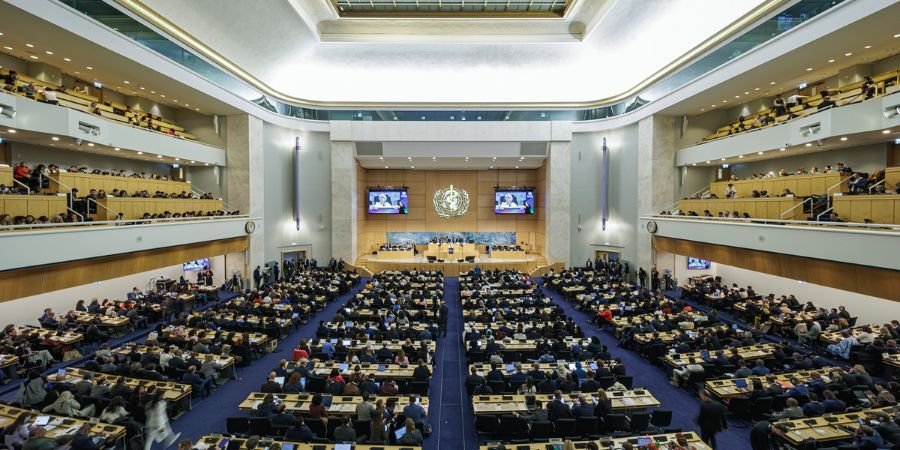
The 79th World Health Assembly just wrapped up in Geneva. More than 190 countries sent delegations. The European Parliament sent six MEPs. And the decisions made over those six days will shape global health policy for years.
If you follow EU health policy, pandemic preparedness, or global governance, this is worth understanding properly.
What is the World Health Assembly?
The World Health Assembly is the decision-making body of the WHO. It is attended by delegations from all WHO Member States and focuses on a specific health agenda prepared by the Executive Board.
It meets once a year, typically in May, in Geneva. Every WHO member state sends a delegation. They debate and vote on resolutions and decisions that set the WHO’s direction, budget, and policy priorities for the year ahead.
The WHA is composed of delegations from all 193 Member States, since the USA formally withdrew. The Executive Board is composed of 34 individuals elected for three years, with its annual meeting taking place in January.
The WHA does not have direct legislative power over its member states. But its resolutions carry significant political weight, they represent binding commitments that governments have agreed to pursue, and they shape the international health agenda that domestic health ministries respond to.
Why Does the European Parliament Send MEPs to the WHO?
The European Parliament is not a WHO member state. So why does it send a delegation?
The SANT committee is officially responsible for inter-institutional relations with other health authorities such as the European Centre for Disease Prevention and Control (ECDC) and the World Health Organisation (WHO).
In practical terms, the delegation serves three purposes. First, it allows MEPs to observe and engage with global health governance at first hand, understanding what WHO member states are actually debating and deciding. Second, it builds relationships with WHO leadership and other national delegations. Third, it feeds directly into the European Parliament’s own legislative work on health, because what gets agreed at the WHA often becomes the foundation for EU health policy.
The SANT committee was upgraded from a subcommittee to a fully-fledged committee in December 2024, with 43 members, up from 30 MEPs, following the Covid-19 pandemic’s demonstration of the need for a strong European Health Union.
Who Were the Six MEPs at WHA79?
The delegation was composed of six Members: Tilly METZ (Greens), Nicolás GONZÁLEZ CASARES (S&D), Ondrej DOSTÁL (NI), Vlad VASILE-VOICULESCU (Renew), Ivan DAVID (ESN), and Aurelijus VERYGA (ECR).
The delegation spanned six different political groups, from the Greens on the left to the ECR and ESN on the right. That breadth is deliberate. WHO engagement is treated as a non-partisan health governance matter rather than an ideological one, even if individual MEPs carry different priorities into the conversations.
The delegation was present from 20 to 22 May, during the middle of the Assembly’s six-day session (18-23 May 2026).
What Was on the Agenda at WHA79?
The 79th World Health Assembly convened in Geneva from May 18-23, 2026, under the theme “Reshaping global health: a shared responsibility.”
The decisions and resolutions addressed topics including mental health, digital health and artificial intelligence, global health reform, rare diseases, antimicrobial resistance, and the annex to the WHO Pandemic Agreement on the Pathogen Access and Benefit Sharing system.
What Did WHA79 Actually Decide?
The assembly adopted more than 20 decisions and 13 resolutions on issues including stroke, tuberculosis, antimicrobial resistance, emergency care, haemophilia, precision medicine, and radiation.
Here are the most significant outcomes:
Antimicrobial Resistance – A New 10-Year Plan
The assembly adopted the Global Action Plan on Antimicrobial Resistance (GAP-AMR) for 2026-2036, renewing global commitments to strengthen the response to AMR. The plan aims to achieve a 10% reduction in bacterial AMR-associated deaths in humans, reduce antimicrobial use in agrifood systems, and minimise environmental pollution from resistant microbes by 2030.
Antimicrobial resistance, the process by which bacteria, viruses, and fungi evolve to defeat the drugs designed to kill them, is one of the most serious slow-moving health crises in the world. The GAP-AMR gives countries a renewed framework to act on it.
Health and Economic Policy – A New Strategy
The World Health Assembly approved a decision to adopt the Strategy on the economics of health for all (2026-2030), marking a significant step towards aligning economic systems with health, equity, and sustainable development.
This is a strategic framework designed to push health considerations into economic and fiscal policy, essentially arguing that health cannot be treated as separate from how governments manage their economies.
Radiation and Health
Through a new resolution, Member States committed to strengthening national systems for radiation protection, including improved monitoring of exposure, workforce training, and the integration of radiation risk management into broader public health programmes. The resolution also emphasises the safe and equitable use of radiation in medical imaging, radiotherapy, and radiopharmaceuticals.
Health Workforce Ethics
Key revisions to the WHO Code of Practice on international recruitment of health personnel were adopted, incorporating provisions covering health workers recruited internationally for employment as care workers, and clarifying the applicability of the Code’s recommendations during emergencies. The revised Code encourages co-investment in health systems so that international recruitment generates proportional benefits for both source and destination countries.
This matters particularly for countries that lose trained doctors and nurses to wealthier nations, a long-standing problem in global health equity.
First-Ever Resolutions on Stroke and Steatotic Liver Disease
WHO Director-General Dr Tedros Adhanom Ghebreyesus noted in his closing remarks that the assembly adopted resolutions on diagnostic imaging, emergency care, haemophilia, NTDs, pharmacovigilance, precision medicine, radiation, steatotic liver disease, stroke, transplantation, and tuberculosis.
The stroke resolution in particular was a first, a recognition that stroke is a leading cause of death and disability globally that had not previously received dedicated WHA-level attention.
What Happened With the Pandemic Agreement PABS Annex?
Background: The text of the WHO Pandemic Agreement was formally approved by WHO member states at the 78th World Health Assembly on 20 May 2025. Work then proceeded on an annex to the Agreement establishing a mechanism for pathogen access and benefit sharing (PABS). The Agreement will not become final and ready for signature until this annex is finalised and approved by a further WHA.
What PABS is: The PABS system is designed to correct the inequities observed during COVID-19, when pathogens were often detected in the Global South but vaccines and therapeutics were hoarded by the Global North. Under the PABS framework, countries are required to promptly share pathogen samples and genetic sequence data. In return, pharmaceutical manufacturers using that data must share the benefits, including providing 20% of their real-time pandemic production to the WHO for distribution based on public health needs, with at least half of this donated outright.
The divide: A bloc of approximately 100 low-and middle-income countries continued to call for mandatory benefit sharing, including guaranteed access to vaccines, therapeutics, and diagnostics as the price of their rapid sharing of information on novel pathogens. High-income countries remained focused on protecting the pharmaceutical innovation ecosystem and ensuring open access to pathogen sequence data.
The outcome at WHA79: Member States agreed to continue drafting the PABS Annex. The final outcome is now expected by May 2027 or at a special session in 2026.
WHO Director-General Dr Tedros said: “Real progress was made on the PABS annex and I am confident through continued negotiations differences will be overcome. Member States should continue approaching the outstanding issues with a sense of urgency because the next pandemic is a matter of when, not if.” The IGWG will hold its seventh meeting from 6 to 17 July 2026.
What Did the EU Say at WHA79?
In the EU’s statement on WHO’s work in health emergencies at WHA79, the EU spoke on behalf of all 27 member states, with candidate countries North Macedonia, Montenegro, Serbia, Albania, Ukraine, Moldova, and Georgia aligning themselves with the statement. The EU expressed alarm at the multitude of health emergencies globally and condemned attacks on civilians, healthcare workers, and aid workers, calling on all parties to an armed conflict to facilitate the functioning of medical establishments and protect them from harm.
Key Takeaways
- The 79th World Health Assembly ran from 18-23 May 2026 in Geneva, under the theme “Reshaping global health: a shared responsibility.”
- Six MEPs from the European Parliament’s SANT (Public Health) Committee attended as a delegation from 20-22 May.
- WHA79 adopted more than 20 decisions and 13 resolutions covering AMR, stroke, TB, radiation, precision medicine, and health workforce issues.
- The Global Action Plan on Antimicrobial Resistance 2026-2036 was adopted, targeting a 10% reduction in AMR-associated deaths by 2030.
- The PABS annex to the WHO Pandemic Agreement was not finalised, negotiations have been extended to May 2027 or a special session.
- The EU spoke on behalf of all 27 member states on health emergencies, condemning attacks on healthcare workers in conflict zones.